

Turn on the kitchen faucet, fill a glass, and the water is there within seconds. Because the process feels so immediate, it is easy to think of the water supplied by your municipality and the water coming from your faucet as exactly the same thing.
Understanding how drinking water gets to your home means looking at the entire path water takes—from the municipal system, through the public distribution network, onto your property, through your home’s plumbing, and finally to the faucet where you drink or cook with it.
That distinction matters because municipal water information describes an important part of the water supply, but your actual drinking water experience happens at the end of a much longer route. Once water reaches your property, the home’s plumbing becomes part of that journey.
This does not mean something is necessarily wrong with the municipal supply or your plumbing. Instead, understanding the full path gives homeowners better context for thinking about the water they actually use every day.
There is more to the journey.
Table of Contents
How Does Drinking Water Get to Your Home?
For homes connected to a municipal water system, drinking water generally follows a path that looks like this:
Water source → municipal treatment → public distribution system → property connection → household plumbing → faucet
Each stage plays a different role.
The municipality manages the public portion of the water system, including treatment and distribution. But municipal treatment is not the final stop. After water enters the distribution network, it still has to travel to your property and through your home’s plumbing before reaching a kitchen faucet.
Most of this journey happens out of sight. Water mains are underground. Service connections are easy to overlook. Supply piping is often hidden behind walls, beneath floors, or inside cabinets.
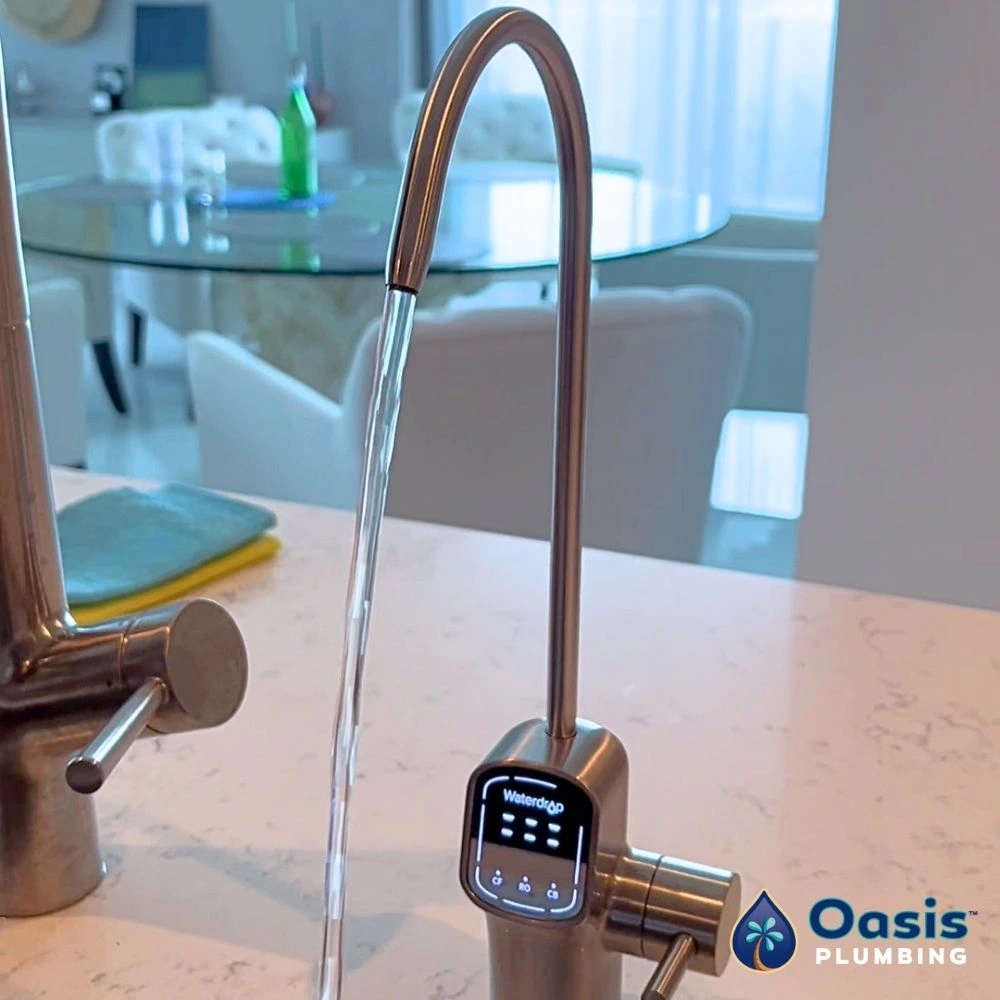
The faucet is where that hidden journey finally becomes visible.
Understanding each stage makes it easier to see why information about the municipal water supply and your experience at an individual faucet are connected but describe different points along the same path.
Understand the Water Reaching Your Faucet
Call Oasis Plumbing at (305) 703-8220 for a professional water-quality evaluation focused on the water your household actually uses.
Step 1: Drinking Water Starts With a Water Source
Before drinking water enters the municipal system, it has to come from a source.
Depending on the community and local water system, that source may be groundwater, surface water, or another managed supply. The water is collected and moved into the municipal treatment process before being distributed to homes and businesses.
Homeowners do not need to understand every technical detail of sourcing to understand the larger journey. The key point is that the source represents the beginning—not the end—of the process.
From here, the water still has several stages to complete before it reaches your glass.
Step 2: Water Goes Through Municipal Treatment
After water enters the municipal system, it goes through treatment before being distributed through the public water network.
Treatment processes vary depending on the water source and the system serving the community. Municipal water systems also monitor water as part of operating the public supply.
For homeowners, municipal treatment provides important context for understanding drinking water. However, it represents one stage of the overall route.
After treatment, water does not travel directly from the treatment facility to your kitchen sink. It enters a distribution system designed to carry water throughout the community.
That distinction becomes important whenever homeowners compare general information about their municipal water with what they personally experience at home. They are looking at two different points in the same journey.
Step 3: Treated Water Enters the Public Distribution System
Once municipal treatment is complete, water enters the public distribution network.
This network includes the infrastructure responsible for carrying water throughout neighborhoods and communities. Water mains run beneath streets and other public areas, allowing water to reach individual properties.
This stage can cover a significant portion of the water’s overall journey, yet homeowners rarely see it.
When you turn on a faucet, water is available because this larger network has already transported it from the municipal system to the area serving your property.
This is also why the phrase “municipal water” can sometimes oversimplify what happens before water reaches a faucet. Municipal treatment establishes an important starting condition, but treated water still has to move through distribution infrastructure before reaching individual homes.
Step 4: Water Reaches Your Property
The next major transition occurs when water reaches the connection serving your property.
Until this point, the journey has largely involved municipal infrastructure. From here, the path becomes increasingly specific to the individual home.
Water moves from the public distribution network toward the property’s water-supply system. The exact configuration can differ among homes, but the principle remains the same: water must make the transition from the public system to the property before it can reach any indoor fixture.
For homeowners in established communities such as Miami Shores, thinking about this transition can be useful because neighboring properties may receive water from the same public system while having different plumbing configurations inside their homes.
The municipal supply may be shared, but the final portion of the journey is not.
That does not mean one home’s plumbing is better or worse than another. It simply means the water’s route becomes property-specific once it moves beyond the public distribution network.
Understand the Property Side of the Journey
Call Oasis Plumbing at (305) 703-8220 to evaluate the water at your home’s point of use instead of relying on assumptions about the supply alone.
Step 5: Your Home's Plumbing Becomes Part of the Journey
Once water reaches the property, the home’s plumbing distributes it to individual fixtures.
Supply piping carries water to the kitchen, bathrooms, laundry area, outdoor fixtures, and other locations where water is needed. When you open the kitchen faucet, water moves through the plumbing serving that particular fixture before leaving the tap.
This is an important part of understanding how drinking water gets to your home because household plumbing is separate from the public distribution network.
Every property has its own plumbing configuration. Homes can differ in pipe materials, layouts, fixture components, and the routes water takes to reach different parts of the house.
Those differences do not automatically indicate a plumbing defect. They simply demonstrate why the final stage of the water journey is specific to the property.
Even within the same house, the route to one faucet may not be identical to the route to another. Different branches of the plumbing system may serve different fixtures.
For drinking water, that makes the kitchen faucet—or whichever fixture the household regularly uses for drinking and cooking—the final destination that matters most.
Step 6: Water Finally Reaches the Faucet
The faucet is where the entire water journey becomes part of everyday life.
You fill a glass, make coffee, prepare meals, rinse produce, or refill a water bottle. Everything that happened before that moment—from sourcing and treatment to distribution and household plumbing—led to this final point of use.
This helps clarify an important difference between two common homeowner questions:
What water is my municipality supplying?
and
What water am I experiencing at my faucet?
The questions are closely related, but they look at different stages.
Municipal information helps homeowners understand the public water supply. The faucet represents water after it has continued through the distribution network, reached the property, moved through household plumbing, and arrived at a specific fixture.
Neither perspective replaces the other.
Instead, understanding both provides a more complete picture of how drinking water reaches the point where you actually use it.
Focus on the Water You Actually Use
Call Oasis Plumbing at (305) 703-8220 for a professional evaluation of the drinking water at your household’s point of use.
Why Municipal Water and Faucet Water Are Related but Not Identical Concepts
It is useful to think of municipal water information as describing an earlier stage of the water’s journey.
The water coming from your kitchen faucet has already passed through that stage. It has also completed several additional stages before reaching you.
That is why a municipal water report and an evaluation of water at a particular faucet answer different questions.
Municipal information helps explain the broader public supply. Faucet-level information focuses on the water after it has traveled the remaining distance to a specific home and fixture.
This does not mean homeowners should assume the water changes negatively somewhere along the route.
The distinction is about context, not diagnosis.
Imagine tracking a delivery. Knowing where a package started tells you something important, but knowing its full route gives you a better understanding of how it eventually reached your door.
Drinking water follows a similar principle. Municipal treatment and distribution are essential parts of the process, while your property and plumbing make up the final portion before the water reaches you.
Understanding that complete route gives homeowners a more accurate framework for thinking about household drinking water.
Why the Final Stretch of the Water Journey Matters
The final stretch matters because it is specific to your property.
Once water leaves the public distribution portion of its journey and enters a home’s plumbing, it is moving through infrastructure unique to that property. The configuration, materials, fixtures, and routes can differ from those in the house next door.
That is an important distinction without needing to assume that anything is wrong.
A homeowner may know a great deal about the municipal system and still have questions about the water at a particular faucet. Those questions are not necessarily questions about the municipality. They may simply reflect an interest in understanding the final point of the water’s journey.
This is particularly useful when homeowners encounter broad statements about “local water”. Local water information provides valuable context, but an individual household’s drinking water experience happens after the water has completed its route to that specific home.
For homeowners, the practical lesson is simple:
Understand the municipal supply as the starting context, and understand the faucet as the endpoint of your household water journey.
Why the Faucet Is the Most Relevant Endpoint for Drinking Water
Every fixture has a purpose, but when the question specifically concerns drinking water, the fixture used for drinking and cooking becomes particularly relevant.
For many households, that is the kitchen sink.
This is where water transitions from the plumbing system into direct household use. It is where you fill glasses, prepare beverages, cook food, and perform other everyday tasks involving water you may consume.
Looking at drinking water from this endpoint keeps the question appropriately focused.
Instead of trying to make broad conclusions about every gallon of water entering the property, homeowners can consider the specific point where drinking water is actually used.
This point-of-use perspective is also why understanding the entire journey is valuable. It connects the broad municipal supply with the specific faucet that matters to your household.
Get Clear Answers at the Kitchen Sink
Call Oasis Plumbing at (305) 703-8220 to evaluate your drinking water at the faucet where your household uses it most.
Understanding the Journey Helps You Ask Better Water-Quality Questions
Without understanding the municipal-to-faucet journey, homeowners can easily treat water quality as a single question.
In reality, there are different questions depending on which part of the journey you are trying to understand.
You might want information about the municipal water supply. You might want to understand the route water takes through your property. Or you might want more information specifically about the water at the kitchen faucet.
Recognizing these distinctions can prevent homeowners from jumping to conclusions.
It also creates a clearer starting point if you decide you want more information about your drinking water. Rather than assuming the answer based solely on municipal information or trying to diagnose household plumbing yourself, you can focus on the point of use that matters to you.
A plumber in Miami Shores, for example, can help a homeowner look at the household side of the water journey without turning general questions about drinking water into assumptions about plumbing problems.
The goal is understanding first.
Once you understand which part of the water journey you actually have questions about, deciding what information or evaluation you need becomes much more straightforward.
Where Water Quality Evaluation Fits
If municipal information explains the broader public supply but your question is specifically about the water at your faucet, a point-of-use water-quality evaluation can provide additional context.
This is the natural next step in understanding the journey because it focuses on the endpoint rather than trying to infer faucet-level conditions solely from information about earlier stages.
An evaluation does not begin with the assumption that something is wrong. Its purpose is to give homeowners more information about the water they actually use for drinking and cooking.
That information can then support a more informed decision about whether anything else needs to be considered.
Evaluate Before You Make a Water Decision
Call Oasis Plumbing at (305) 703-8220 for a drinking water evaluation focused on the water reaching your kitchen faucet.
Where Point-of-Use Filtration Fits Into the Bigger Picture
Understanding the water journey also explains why some homeowners eventually consider point-of-use drinking water filtration.
A point-of-use approach focuses on drinking water at the fixture where it is actually consumed, rather than changing how water is treated throughout the entire home.
That makes it a logical topic to consider after understanding the municipal-to-faucet journey and evaluating the water at the point of use.
It does not mean every household needs filtration, and understanding the journey alone is not a reason to install a system.
The progression is simply:
Understand the journey → evaluate the water at the faucet → determine whether point-of-use filtration is appropriate.
That keeps the decision based on the household’s actual drinking water needs rather than assumptions about the municipal supply or the plumbing system.
Key Takeaways
Drinking water travels through several stages before reaching your faucet. The journey includes the water source, municipal treatment, public distribution system, property connection, household plumbing, and final fixture.
Municipal treatment is an important stage, but it is not the end of the journey. Water continues through additional infrastructure before reaching your home.
The journey becomes property-specific once water reaches your home. Your household plumbing forms the final route between the public supply and individual fixtures.
Municipal water information and faucet-level information answer different questions. One provides context about the public supply, while the other focuses on the endpoint where your household actually uses the water.
Understanding the journey does not mean assuming something is wrong. The purpose is to give homeowners a more complete picture of how water reaches them.
For drinking water, the point of use matters. The kitchen faucet is often the final destination for water used for drinking and cooking.
Evaluation can bridge the information gap. If you want to know more about water at your faucet, evaluating that specific point provides more relevant information before considering filtration.
Understanding how drinking water gets to your home provides a clearer way to think about what happens between the municipal system and your kitchen faucet.
Water begins at a source, goes through municipal treatment, travels through the public distribution network, reaches your property, moves through your home’s plumbing, and finally comes out of the fixture where you use it.
Municipal water information therefore provides important context, but your drinking water experience happens at the endpoint of that entire journey.
That distinction does not suggest there is necessarily a problem somewhere along the way. It simply recognizes that the water supplied to a community and the water experienced at an individual faucet represent different stages of the same system.
Once homeowners understand that journey, they can ask more specific questions about the water they actually drink and cook with—and make better-informed decisions about whether point-of-use evaluation or filtration deserves consideration.
If you want a clearer picture of the drinking water your household actually uses, start at the point where the journey ends.
Oasis Plumbing can evaluate drinking water at your point of use and help you understand whether point-of-use filtration is appropriate for your household. The goal is to make the next decision based on your home’s actual water experience rather than assumptions about the municipal supply.
Call Oasis Plumbing at (305) 703-8220 to schedule a drinking water evaluation and discuss your point-of-use filtration options.
