

If most of the drinking water in your home comes from the kitchen sink, you may have wondered whether installing a filter directly beneath it would make everyday life easier.
For some Shorecrest homeowners, the answer is yes. An under-sink drinking water filter can provide filtered water at the exact place where you fill glasses and reusable bottles, make coffee, prepare meals, and get water for cooking. Instead of treating water throughout the entire home, it focuses specifically on the point where drinking and cooking water is used.
But that does not automatically mean an under-sink filter is worthwhile for every household.
The real question is whether the convenience and focused approach match the way your household actually uses water. A family that fills multiple water bottles every morning and cooks at home regularly may get much more practical value from an under-sink system than someone who rarely uses the kitchen faucet for drinking water.
Your kitchen setup matters, too. Available cabinet space, the plumbing beneath the sink, and other equipment already occupying the cabinet can affect how practical the installation will be.
So, is an under sink water filter worth it? For many Shorecrest homeowners, it can be when filtered drinking and cooking water is used frequently at one sink and having it readily available would simplify the household’s routine.
Before deciding, it helps to understand exactly what an under-sink system is designed to do—and what it isn’t.
Table of Contents
What Does an Under-Sink Drinking Water Filter Actually Do for Your Home?
An under-sink drinking water filter is a point-of-use system. That means it treats water at a specific location rather than throughout the entire home.
In most households, that point of use is the kitchen.
This distinction is important because homeowners sometimes assume that wanting filtered drinking water means they need to filter the water supplied to every fixture. Those are two different goals.
If your main objective is having filtered water available for drinking, cooking, making coffee, filling reusable bottles, and similar kitchen activities, treating the kitchen point of use may be enough for what you actually want.
You aren’t necessarily trying to change the water used for showers, toilets, laundry, outdoor faucets, and every bathroom sink. You’re creating a dedicated source of filtered water where your household is most likely to consume it.

For a Shorecrest homeowner who already gets most drinking and cooking water from the kitchen, that focused approach can make an under-sink system practical without expanding the project beyond its intended purpose.
The first question to ask, therefore, isn’t whether your entire home needs filtration.
It’s much simpler:
Where does your household actually want filtered water?
If the answer is primarily the kitchen sink, an under-sink system deserves consideration.
Start With the Sink You Actually Use
Have Oasis Plumbing evaluate your Shorecrest kitchen, household drinking-water needs, and sink configuration for point-of-use filtration—call (305) 703-8220.
When Is an Under-Sink Water Filter Worth It?
An under-sink water filter in Shorecrest is generally most worthwhile when your household regularly uses filtered water and wants it conveniently available at one primary location.
Consider what happens during a typical day in your home.
You might fill several reusable bottles before work or school. Someone makes coffee in the morning. Water is needed while preparing lunch or dinner. Glasses are filled throughout the day. A kettle needs water for tea. A pot needs to be filled before cooking.
If most of those activities start at the kitchen sink, installing drinking water filtration at that location aligns naturally with an existing household routine.
That is one of the strongest arguments for an under-sink system: you don’t have to create a new routine to use it.
Contrast that with a household that rarely drinks water from the kitchen faucet. Perhaps most meals are eaten away from home, drinking water comes from another source, or filtered water is used only occasionally. In that situation, the practical benefit of installing a permanent point-of-use system may be smaller.
There is no universal threshold that determines when an under-sink filter becomes worthwhile. Instead, consider frequency.
If filtered water would be used several times every day, convenience becomes more meaningful. If it would be used only occasionally, a permanent drinking water filter installation may provide less day-to-day value.
How Your Household's Drinking and Cooking Habits Affect the Decision
One of the best ways to evaluate an under-sink filter is to stop thinking about the equipment for a moment and look at your household’s routine instead.
How much water do you actually use in the kitchen?
A Shorecrest family that prepares most meals at home could use kitchen water repeatedly from morning through evening. Another household may use the kitchen primarily on weekends. A homeowner living alone may have completely different habits from a larger family.
Those differences matter.
Consider how frequently you use water for:
Filling drinking glasses and reusable bottles
Making coffee or tea
Preparing meals
Filling pots for cooking
Mixing beverages
Filling water containers before leaving home
Other regular kitchen drinking-water uses
You don’t need to calculate gallons or create a detailed usage estimate. You’re simply trying to determine whether filtered water at the kitchen sink would become an everyday convenience or an occasional feature.
Imagine two Shorecrest households.
In the first, four family members fill reusable bottles every morning, meals are regularly prepared at home, and the kitchen sink is the household’s primary source of drinking water. Having filtered water readily available at that point of use could remove several small inconveniences throughout the day.
In the second household, the kitchen faucet is rarely used for drinking water and cooking happens infrequently. Even if an under-sink system works perfectly well for the space, the household may simply not use it enough to consider it valuable.
The equipment could be identical.
The value isn’t.
That’s why your household habits should play such a large role in answering whether an under-sink water filter is worth it.
How Much Does Convenience Matter to You?
Convenience is one of the biggest practical reasons homeowners consider under-sink filtration.
There are other ways to keep filtered drinking water available. Some households use pitchers. Others use countertop dispensers or purchase bottled water.
Each approach creates its own routine.
A pitcher needs to be filled and usually takes up refrigerator space. A countertop option occupies kitchen workspace. Bottled water has to be purchased, brought home, stored, and replenished.
For households that are comfortable with those routines, there may be little reason to change them.
But if those routines have become inconvenient, an installed under-sink system can offer a different experience.
Instead of thinking ahead about whether the pitcher has been filled or whether enough bottled water is available, filtered water is located where the household already goes to get water.
For homeowners with limited kitchen workspace, moving the filtration equipment below the counter can also keep countertops available for food preparation and appliances. The tradeoff is that the system needs appropriate space inside the cabinet.
This is where “worth it” becomes personal.
A household that uses filtered water once or twice a week may barely notice the difference. A household that reaches for filtered water ten or twenty times throughout a day may value that convenience much more.
Make Filtered Water Part of Your Kitchen Routine
Call Oasis Plumbing at (305) 703-8220 to evaluate whether an under-sink drinking water filter fits the way your Shorecrest household uses water every day.
Do You Need Whole House Filtration Just to Get Filtered Drinking Water?
No. Wanting filtered drinking water at your kitchen sink does not automatically mean you need filtration at every fixture in your home.
This is an important distinction when evaluating point-of-use filtration.
An under-sink drinking water filter has a focused job: provide filtered water at the specific point where the system is installed.
For homeowners primarily interested in the water they drink and cook with, that may match the goal very well.
Consider the other ways water is used around your home. Toilets, showers, laundry, outdoor faucets, and many other fixtures account for water use that is separate from your drinking-water routine.
If your objective is simply to have a dedicated source of filtered water for consumption and food preparation, you may not see a practical reason to include every one of those fixtures in that objective.
On the other hand, if your expectations involve water at numerous fixtures throughout the property, an under-sink system has an obvious limitation: its benefits remain concentrated at its specific point of use.
That doesn’t make point-of-use filtration inadequate. It simply means the system needs to match the homeowner’s actual objective.
A useful way to frame the decision is:
Do I want filtered drinking water, or am I trying to address water throughout my entire home?
For the first goal, an under-sink system can make practical sense. The second is a different scope entirely.
What Are the Practical Advantages of an Under-Sink Water Filter?
The value of an under-sink drinking water filter usually comes from a combination of convenience, focused use, and how easily it fits into the household’s routine.
Filtered water is available at a high-use location
For many households, the kitchen sink is already the central location for drinking and cooking water. Installing filtration there puts filtered water where household members naturally expect to find it.
It focuses on the water you plan to consume
If your primary concern is drinking and cooking water, point-of-use filtration keeps the solution focused on that specific objective rather than automatically expanding filtration to unrelated fixtures.
It can reduce reliance on separate drinking-water routines
Homeowners who regularly fill pitchers, manage countertop dispensers, or store bottled water may value having an installed drinking-water source in the kitchen instead.
Much of the equipment stays beneath the counter
An under-sink setup can preserve visible countertop space because the filtration equipment is housed inside the cabinet. For kitchens where usable counter space is valuable, this can be an appealing advantage.
It fits naturally into established household habits
Perhaps the biggest practical benefit is that you continue going to the kitchen for water just as you already do. The filtration becomes part of an existing routine rather than another household task that needs to be remembered.
These advantages matter most when they solve a problem or inconvenience that your household actually experiences.
Keep the Solution Focused
Oasis Plumbing can evaluate whether point-of-use filtration matches your Shorecrest home’s drinking and cooking habits—call (305) 703-8220.
What Are the Limitations of an Under-Sink Water Filter?
The biggest limitation is also what defines point-of-use filtration: it serves a specific location.
If you install a drinking water filter beneath your kitchen sink, you should not expect that system to provide filtered water throughout every fixture in the house.
For some homeowners, that isn’t a drawback at all.
If the kitchen is where virtually all drinking and cooking water is obtained, filtering that one location may provide exactly the level of convenience the household wants.
The limitation becomes important when expectations are broader.
For example, imagine a homeowner wants filtered drinking water from several sinks throughout the property. Installing one system under the kitchen sink would not accomplish that entire objective.
That is why expectations should be established before installation.
Point-of-use filtration can be highly practical when the homeowner’s goal is equally focused. It becomes less aligned when the desired result extends far beyond the point where the system operates.
Understanding that limitation prevents a homeowner from choosing a narrowly focused solution for a household-wide objective.
Will an Under-Sink Water Filter Fit in Your Kitchen?
Once you’ve determined that point-of-use filtration fits your drinking-water habits, the next question is whether your kitchen can accommodate the installation.
This isn’t always as simple as looking under the sink and seeing an empty corner.
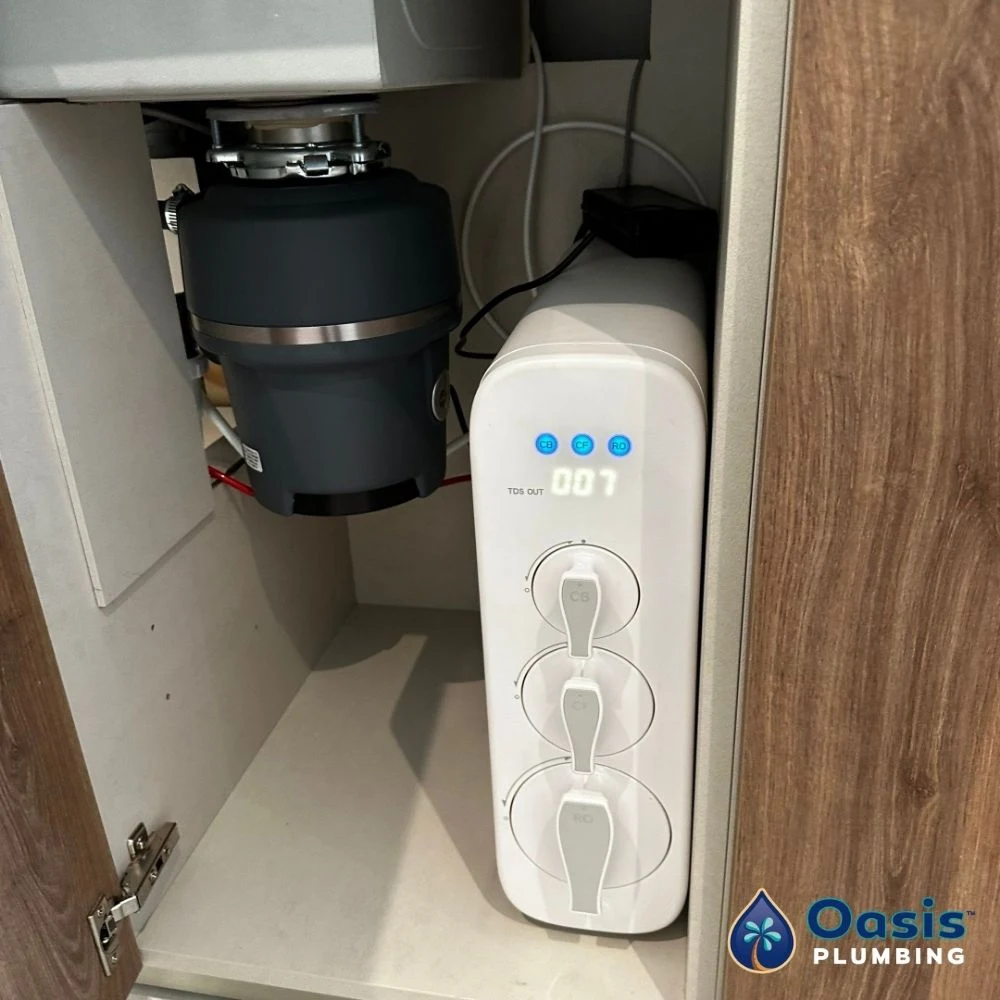
Kitchen cabinets often contain drain piping, water supply connections, garbage disposals, cleaning products, storage systems, or other equipment. All of those can affect usable installation space.
Shorecrest homes can also have very different kitchen configurations. Some properties retain more compact layouts, while others have remodeled kitchens with different sinks, cabinetry, disposals, or plumbing arrangements.
The age of the property itself doesn’t determine whether you should install a drinking water filter. What matters for this decision is the current physical configuration of the kitchen.
A cabinet may look spacious until you account for the equipment already installed inside it. Conversely, a smaller cabinet may still have a workable configuration depending on how the existing plumbing is arranged.
The goal isn’t simply to squeeze filtration equipment into whatever space remains.
The system needs to coexist appropriately with the sink’s existing plumbing and other equipment while keeping the installation practical for the homeowner.
That’s why looking at the actual kitchen configuration is an important part of deciding whether an under-sink system makes sense.
Why Professional Evaluation Matters Before Drinking Water Filter Installation
By the time you’re seriously considering an under-sink drinking water filter, you’ve probably already answered the lifestyle side of the decision.
You know where your household gets its drinking water. You know whether convenience matters. You know whether your goal is focused on the kitchen rather than the entire home.
What may be harder to determine yourself is whether the existing sink configuration supports the installation properly.
A plumber can evaluate practical factors such as available cabinet space, existing connections, the arrangement of plumbing beneath the sink, and other equipment that may affect the installation.
This is particularly useful in Shorecrest homes where kitchen layouts and previous renovations can produce very different under-sink configurations from one property to another.
The evaluation should also connect the physical installation to what the household actually wants.
For example, there is little value in planning a point-of-use installation without first confirming that the kitchen is genuinely where the homeowner wants filtered drinking water available.
Professional evaluation therefore isn’t just about determining whether equipment can physically fit.
It’s about answering:
Does this installation make practical sense for this household and this kitchen?
Know What Your Kitchen Can Support
Have Oasis Plumbing inspect your Shorecrest sink configuration, available cabinet space, and installation requirements before moving forward—call (305) 703-8220.
Three Common Homeowner Scenarios: When Is Under-Sink Water Filter Worth It?
Sometimes the easiest way to make the decision is to compare your household with realistic situations.
Scenario 1: A Family That Uses Filtered Water Throughout the Day
A Shorecrest family fills several reusable bottles every morning, makes coffee at home, prepares most dinners in the kitchen, and regularly uses water for cooking.
They currently rely on a filtered-water pitcher, which needs frequent refilling.
For this household, an under-sink system could provide meaningful everyday convenience because filtered water is used repeatedly at one location.
Likely decision: Worth considering.
Scenario 2: A Household That Rarely Uses Kitchen Water for Drinking
Another homeowner spends much of the day away from home and rarely cooks. Drinking water from the kitchen is used only occasionally.
An under-sink system could still provide filtered water at that location, but it wouldn’t significantly change the homeowner’s daily routine.
Likely decision: The practical value may be lower.
Scenario 3: A Household That Wants Filtered Water Only in the Kitchen
A homeowner wants convenient filtered water for drinking, cooking, and filling reusable bottles but has no particular reason to extend that goal to showers, laundry, toilets, and other fixtures.
This is precisely where understanding point-of-use filtration becomes useful. The homeowner can focus the drinking-water setup on the location where it will actually be used.
The remaining question is whether the kitchen’s sink and cabinet configuration can accommodate the installation.
Likely decision: Under-sink filtration is a logical option to evaluate.
These examples illustrate why there isn’t one universal answer.
The value of an under-sink filter depends less on what another homeowner has installed and more on whether it fits your household’s behavior, expectations, and kitchen.
Questions to Ask Before Deciding To Get an Under-sink Drinking Water Filtration
Before moving forward with under-sink drinking water filtration, ask yourself a few practical questions:
Where does my household get most of its drinking water?
If it’s consistently the kitchen sink, point-of-use filtration aligns well with your existing routine.
How often would we actually use filtered water?
Consider drinking, cooking, coffee, tea, and filling reusable bottles rather than thinking only about glasses of water.
Would direct access make our current routine easier?
Think about whether you’re regularly refilling pitchers, storing bottled water, or using countertop space for another drinking-water solution.
Do we only want filtered drinking and cooking water?
If yes, treating one primary point of use may align more closely with your objective than thinking in terms of every fixture in the home.
Is there usable space beneath the kitchen sink?
Remember that plumbing, a garbage disposal, storage, and other equipment can reduce the amount of practical installation space.
Has the sink configuration been evaluated for installation?
A visual glance at the cabinet doesn’t necessarily tell you everything about how a system can be integrated with the existing plumbing.
If your answers consistently point toward frequent kitchen use, a desire for convenience, and a focused drinking-water goal, an under-sink system becomes a much stronger option to consider.
Is an Under Sink Water Filter Worth It in Shorecrest?
For many Shorecrest homeowners, an under-sink water filter is worth considering when filtered drinking and cooking water is used frequently at the kitchen sink and having it readily available would improve everyday convenience.
The strongest case is usually a household that already treats the kitchen as its main source of drinking and cooking water.
If you’re constantly filling reusable bottles, making coffee, preparing meals, or otherwise using drinking water from that location, point-of-use filtration can fit naturally into your routine.
If you rarely use filtered water, the practical value may be much smaller.
And if your objective extends to water at multiple fixtures throughout the home, remember that one under-sink system is intentionally limited to its point of use.
The final piece is your kitchen itself.
Even when an under-sink filter makes sense for your lifestyle, cabinet space and the existing sink configuration need to support a practical installation.
That combination—household habits, desired point of use, convenience, and installation feasibility—is what should ultimately determine whether an under-sink drinking water filter is worthwhile for your Shorecrest home.
Get an Answer Based on Your Home
Call Oasis Plumbing at (305) 703-8220 to have your Shorecrest kitchen and household needs evaluated for an under-sink drinking water filter.
Key Takeaways
An under-sink drinking water filter is a point-of-use system, meaning it treats water at a specific location rather than throughout the entire home.
It tends to provide the most practical value when a household gets most of its drinking and cooking water from the kitchen.
Families that frequently fill reusable bottles, prepare meals, make coffee or tea, and use kitchen water throughout the day may benefit more from the convenience.
Wanting filtered drinking water does not automatically mean you need filtration at every fixture in your home.
Under-sink filtration can reduce reliance on pitchers, countertop drinking-water setups, or bottled-water routines when those have become inconvenient.
Its primary limitation is that the filtration remains at the point of use rather than serving every fixture.
Cabinet space and existing sink plumbing can affect whether installation is practical.
Shorecrest homeowners should base the decision on their household routines and actual kitchen configuration rather than assuming every home needs the same drinking-water setup.
A plumbing evaluation can confirm whether the sink configuration, available space, and installation requirements align with the household's point-of-use filtration goals.
So, is an under sink water filter worth it in Shorecrest?
It can be—especially when your household regularly drinks and cooks with water from the kitchen and you want filtered water available there without relying on a separate pitcher, countertop setup, or bottled-water routine.
The key is keeping the decision focused on what you’re actually trying to accomplish.
An under-sink drinking water filter isn’t intended to filter water throughout your entire Shorecrest home. It is a point-of-use solution designed to provide filtered water at a specific location. For homeowners primarily interested in drinking and cooking water, that narrower scope may be exactly what makes it practical.
Your daily habits ultimately matter more than what another household chooses. Consider how often you use kitchen water, whether direct access to filtered water would make your routine easier, and whether the existing sink and cabinet configuration can accommodate the installation.
When those factors line up, an under-sink system can be a practical addition to the kitchen rather than an unnecessary whole-home project.
If you’re already considering an under-sink drinking water filter, you don’t have to guess whether your kitchen is suited for the installation.
Oasis Plumbing can evaluate your sink configuration, available cabinet space, existing plumbing, and household drinking-water needs to determine what is required for a point-of-use installation in your Shorecrest home.
Call Oasis Plumbing at (305) 703-8220 to schedule an evaluation for under-sink drinking water filter installation in Shorecrest.
