

Finding out that tree roots have entered your home’s sewer line can raise an immediate concern: Does this mean the pipe is broken?
It’s a reasonable question. Sewer pipes are supposed to carry wastewater through an enclosed system, so discovering roots inside one suggests that something has allowed them to enter.
However, tree roots in sewer line piping do not automatically mean the entire pipe is broken or that the sewer line needs replacement.
Roots generally enter through an existing opening, such as a compromised joint, crack, or another defect that provides access to the pipe’s interior. Once inside, they can grow and interfere with wastewater movement.
But root intrusion alone doesn’t reveal the full condition of the sewer line.
The significance depends on where the roots entered, the condition of the surrounding pipe, how much growth is present, and whether the intrusion has affected the pipe’s structure.
Understanding what roots can—and cannot—tell you about sewer piping helps separate the presence of an obstruction from the possibility of an underlying structural problem.
Table of Contents
How Do Tree Roots Get Inside a Sewer Line?
Tree roots typically enter sewer piping through an existing opening, such as a compromised joint, crack, or separation between pipe sections.
A properly sealed sewer pipe is intended to contain wastewater while preventing surrounding materials from entering.
However, underground piping contains joints and connections, and those areas may become vulnerable if they lose their integrity.
Cracks or other openings can also provide access. When roots encounter one of these openings, they may grow into the pipe’s interior.
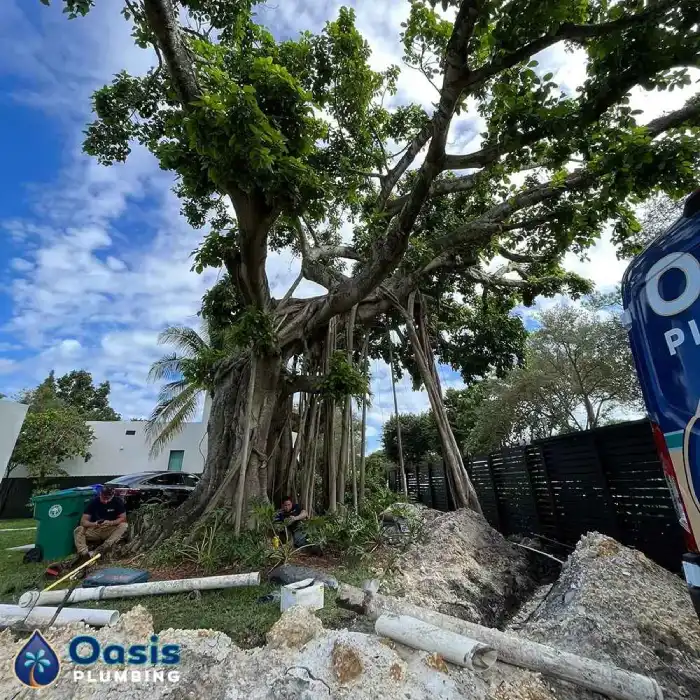
Can Roots Grow Through a Completely Intact Sewer Pipe?
Tree roots generally do not penetrate a sound, properly sealed sewer pipe simply because wastewater is flowing inside it. They usually need an existing pathway.
That pathway may be extremely small, particularly in the early stages of intrusion.
For example, a narrow opening at a pipe joint may allow fine roots to enter without creating an obvious change in drainage performance. Over time, additional root growth may develop within the available space.
However, the presence of roots does not establish exactly when the opening formed or what originally caused it.
Does Root Intrusion Always Mean the Pipe Is Cracked?
No. A crack is one possible entry point, but roots may also enter through compromised joints or other openings.
This distinction matters because homeowners often interpret any root intrusion as proof that a pipe has split apart.
In reality, the entry point may involve a connection between pipe sections rather than a crack along the pipe wall.
Root intrusion suggests that an entry pathway exists, but it does not identify the precise defect on its own.
Found Tree Roots in Your Sewer Line?
Root intrusion may indicate an opening or defect that deserves further evaluation. Oasis Plumbing can help determine whether the affected sewer piping requires attention. Call (305) 703-8220 to discuss your sewer-line concerns.
Why Are Tree Roots Attracted to Sewer Pipes?
Tree roots grow toward areas where moisture and suitable growing conditions are available. A sewer pipe with an opening may create an opportunity for roots to access moisture near or inside the line.
Roots naturally extend through soil as they seek water and nutrients. The soil surrounding underground plumbing may contain moisture from several sources.
If wastewater escapes through a compromised sewer-pipe connection or another opening, the surrounding soil may become locally moist. Roots growing nearby may encounter that area.
If an accessible opening exists, fine roots can enter the pipe.
Do Sewer Pipes Attract Roots Even When They Aren't Leaking?
Roots can grow near buried pipes without the pipes necessarily being damaged.
The presence of a sewer line underground does not mean roots will automatically enter it.
For intrusion to occur, roots generally need a suitable opening.
Moisture conditions around the pipe may influence root growth, but moisture alone does not establish that the pipe is leaking.
This is an important distinction. A homeowner may assume that roots inside a sewer line prove wastewater has been leaking into the surrounding soil.
However, root intrusion does not independently establish the amount of leakage, whether leakage is ongoing, or how the entry point developed.
Those questions require evaluating the actual condition of the pipe.
What Does Finding Tree Roots in a Sewer Line Really Mean?
Finding tree roots inside a sewer line generally indicates that roots have gained access through an opening, but it does not reveal the full extent of the pipe’s condition.
Root intrusion provides useful information. It suggests that the piping is not completely protected from outside root entry at the affected location.
However, several important questions remain unanswered.
For example:
Did the roots enter through a compromised joint?
Is there a crack in the pipe wall?
Has the opening affected the surrounding pipe structure?
Is the defect limited to one location?
Has root growth significantly obstructed wastewater movement?
Is the surrounding pipe otherwise stable?
The presence of roots alone cannot answer all these questions.
What Root Intrusion Can Tell You
Root intrusion can indicate that an entry pathway exists.
It may also show that roots have grown into the pipe’s interior, where they can interfere with wastewater movement.
If roots are concentrated around a particular connection or defect, that location may deserve closer evaluation.
What Root Intrusion Cannot Tell You
Finding roots does not automatically establish:
That the entire sewer line is structurally damaged.
That the pipe has collapsed.
That every joint along the line is compromised.
That wastewater is leaking continuously.
That the pipe must be completely replaced.
That the roots caused the original opening.
These distinctions are important because the condition of one affected section may not represent the condition of the entire sewer system.
Root intrusion is evidence of an access problem, not a complete diagnosis of the sewer line.
Do Tree Roots Cause Sewer Pipe Damage, or Do They Enter Through Existing Damage?
Tree roots commonly enter through an existing opening, but continued root growth may contribute to additional damage in some circumstances.
This creates an important distinction between how roots initially enter a pipe and what may happen afterward.
A compromised joint or crack may provide the original entry point. Once roots enter, they can continue growing.
Depending on the size of the opening, the amount of growth, and the condition of the surrounding material, that growth may place additional stress on vulnerable parts of the pipe.
However, the presence of roots does not prove that they caused the original defect.
When Roots Enter an Existing Defect
Consider a hypothetical sewer pipe with a small opening at a joint. Fine roots growing through nearby soil encounter the opening and enter the pipe.
In this situation, the compromised joint provided the access point. The roots did not necessarily create the original problem.
Their presence reveals that the opening was accessible to surrounding root growth.
When Root Growth Contributes to Further Damage
Now consider a pipe connection that is already weakened.
If roots continue growing within or around the opening, they may place additional stress on the affected area. Depending on the condition of the piping, this could contribute to further separation or damage.
However, that outcome is not inevitable.
Some intrusions may remain concentrated around a limited opening, while others may be associated with more extensive deterioration.
The actual condition of the pipe determines how significant the root intrusion is.
What Is the Difference Between Roots Blocking a Sewer Pipe and Roots Damaging It?
Roots obstructing a sewer pipe affect the space available for wastewater to flow, while structural damage affects the physical condition of the pipe itself.
These problems can occur together, but they are not the same.
Roots may grow into the internal passage and reduce the amount of space available for wastewater. That is a flow-related concern.
A crack, separated joint, or weakened pipe wall is a structural concern.
The presence of one does not automatically establish the full extent of the other.
| Condition | What it means | What it does not automatically prove |
|---|---|---|
| Roots entering through a joint | Roots have accessed the pipe at a connection | That the entire pipe is cracked |
| Roots growing inside the pipe | Root growth occupies part of the internal passage | That the pipe has collapsed |
| Roots restricting wastewater movement | Root growth interferes with available flow space | That the obstruction is caused by extensive structural damage |
| Roots associated with a damaged section | Root intrusion and pipe damage are present together | That roots caused the original defect |
| Roots found in one section | Intrusion has been identified at a particular location | That every section of the sewer line is affected |
Can Roots Be Present Without Completely Blocking the Pipe?
Yes. A limited amount of root growth may occupy part of the pipe while leaving enough space for wastewater to pass.
As a result, the sewer line may continue carrying wastewater even though roots are present.
This is similar to the distinction between structural damage and drainage performance.
A pipe may have an opening that allows roots to enter without immediately losing its ability to convey wastewater.
For a related explanation of how structural defects can exist while drainage continues, see cracked sewer pipe.
However, root growth and pipe cracking are not interchangeable conditions.
The relationship between them depends on the actual entry point and surrounding pipe condition.
Why Doesn't Removing Tree Roots Always Solve the Underlying Problem?
Removing roots from inside a sewer line may address the immediate obstruction, but it does not necessarily eliminate the opening that allowed the roots to enter.
This is one of the most important distinctions homeowners should understand.
There are two separate concerns:
The root growth currently inside the pipe.
The entry point that allowed the roots to reach the interior.
Addressing the first does not automatically correct the second.
For example, imagine that roots entered through a compromised pipe joint. Removing the roots may clear the affected passage.
However, if the joint remains open, the same pathway may still be accessible to future root growth.
The immediate condition inside the pipe may have changed, but the underlying entry point may remain.
Does That Mean Roots Will Always Return?
Not necessarily.
Future root growth depends on several factors, including the remaining entry pathway, nearby root activity, moisture conditions, and the condition of the pipe.
It would be inaccurate to assume that roots will always return within a particular period.
However, if the opening remains accessible, the possibility of additional intrusion may remain.
This is why evaluating the affected pipe section can be important even after the immediate root growth has been addressed.
Why Is the Entry Point More Important Than the Roots Alone?
The roots are the visible evidence of intrusion. The entry point helps explain how the intrusion became possible.
Without understanding that entry point, it may be difficult to determine whether the underlying condition has been resolved.
This does not mean every instance of root intrusion requires extensive sewer-line work.
It means the condition of the affected pipe deserves consideration beyond the presence of roots alone.
Does Finding Tree Roots Mean the Entire Sewer Line Is Damaged?
No. Finding tree roots in a sewer line does not automatically establish that the entire line is damaged or requires replacement.
Root intrusion may be limited to a particular joint or section. The surrounding piping may be in a different condition.
For example, a single compromised connection could provide access to roots while other sections remain structurally intact.
In another situation, root intrusion may occur alongside broader deterioration. The difference cannot be determined simply by knowing that roots were found.
Why Does the Affected Location Matter?
A sewer line consists of connected sections that may experience different conditions.
The location where roots enter may reveal a specific area of vulnerability.
However, that doesn’t mean every connected section has the same defect.
Evaluating the affected location helps determine whether the problem appears localized or whether other pipe conditions require attention.
Can Root Intrusion Exist Without Major Structural Damage?
Yes. An opening at a joint may allow roots to enter without indicating that the entire pipe wall has failed.
However, even a relatively limited opening may matter if it allows repeated intrusion or compromises the pipe’s ability to contain wastewater.
The significance depends on the actual defect.
Root intrusion should not be treated as proof of complete sewer-line failure, but it should not automatically be dismissed as harmless either.
When Should Root Intrusion Lead to Further Sewer-Line Evaluation?
Further evaluation is appropriate when root intrusion has been identified and there is uncertainty about the entry point, surrounding pipe condition, or possibility of continued intrusion.
The goal is not simply to establish that roots are present. It is to understand what their presence reveals about the pipe.
For example, a plumber may need to determine whether roots entered through a joint, crack, or another opening.
The condition of the surrounding pipe also matters. A limited entry point in otherwise stable piping may present a different situation from intrusion associated with a weakened or displaced section.
What Should the Evaluation Help Clarify?
A professional evaluation may help determine:
Where roots entered the sewer line.
Whether the entry point involves a joint, crack, or another defect.
Whether the affected section remains structurally stable.
Whether root growth has restricted wastewater movement.
Whether the surrounding pipe has additional concerns.
Whether corrective work is appropriate.
The findings help distinguish an immediate obstruction from an underlying structural issue.
For homeowners dealing with tree roots in sewer line piping, this distinction is particularly important when intrusion has occurred more than once.
Repeated intrusion may suggest that an accessible entry point remains, although it does not independently establish the extent of pipe damage.
Oasis Plumbing’s sewer line repair and replacement service may be relevant when an evaluation identifies a defect requiring corrective work.
For homeowners in Miami Shores Village, information about sewer line repair in Miami Shores Village is also available.
However, root intrusion alone does not determine what corrective work is necessary.
That decision depends on the condition of the affected piping.
Have Roots Entered Your Sewer Line More Than Once?
Repeated root intrusion may indicate that an entry point remains accessible. Oasis Plumbing can help evaluate the affected sewer piping and determine whether an underlying defect needs attention. Call (305) 703-8220 to discuss your sewer-line concerns.
Key Takeaways
Tree roots in sewer line piping generally indicate that roots have entered through an opening or compromised connection.
Roots are attracted to moisture, but their presence does not automatically prove that wastewater is leaking continuously.
Root intrusion may occur through a crack, joint, or another accessible opening.
Roots can obstruct wastewater movement without establishing that the entire pipe is structurally damaged.
Continued root growth may contribute to further damage in some circumstances, but roots do not necessarily cause the original defect.
Removing roots does not automatically correct the entry point that allowed them inside.
Root intrusion does not mean the entire sewer line requires replacement.
Evaluating the affected section can help determine whether a structural defect needs attention.
Discovering roots inside a sewer line can be concerning, especially when you’re unsure what their presence means for the underground piping.
But roots do not automatically establish that the entire sewer line is broken.
In many cases, they enter through an existing opening, such as a compromised joint or crack. Once inside, they may grow and interfere with wastewater movement.
However, the presence of roots alone does not reveal the full extent of structural damage, whether the pipe is leaking, or what corrective work may be appropriate.
The important question is not simply whether roots are present, but what allowed them to enter and whether the affected pipe section remains structurally sound.
Understanding that distinction helps homeowners avoid assuming that every root intrusion requires extensive sewer-line work.
If roots have been identified inside your sewer piping, our plumbers in Miami Shores at Oasis Plumbing can help evaluate whether the affected section has an underlying defect that requires attention.
Call Oasis Plumbing at (305) 703-8220 to discuss sewer-line concerns in Miami-Dade.
