

An older water pipe may look perfectly normal from the outside, yet the amount of water passing through it can be significantly reduced. How is that possible if the pipe hasn’t changed size?
The answer may be inside the pipe.
Galvanized pipe buildup occurs when corrosion products and other deposits accumulate along the inner walls of galvanized steel piping, reducing the space available for water to flow. As that opening becomes smaller or more irregular, the pipe can create greater resistance to water movement.
This internal restriction is not always visible from the outside. A pipe may retain its original exterior dimensions while its usable internal opening becomes progressively narrower.
However, not every galvanized pipe develops the same degree of buildup, and reduced water flow does not automatically prove that internal corrosion is responsible.
Understanding the physical process helps explain why a water line can become restricted even when its exterior appears unchanged.
Table of Contents
What Is Galvanized Pipe Buildup?
Galvanized pipe buildup is the accumulation of corrosion products and deposits inside galvanized steel water lines that can reduce the opening through which water travels.
A galvanized pipe is manufactured with a hollow passage that allows water to move through it.
When the internal steel surface corrodes, corrosion products can form along the pipe wall. Some material may remain attached to the surface, while other deposits may collect within the pipe.
Over time, these materials can occupy space that would otherwise be available for water.
Instead of moving through the pipe’s original internal opening, water must pass through a smaller or more irregular passage.
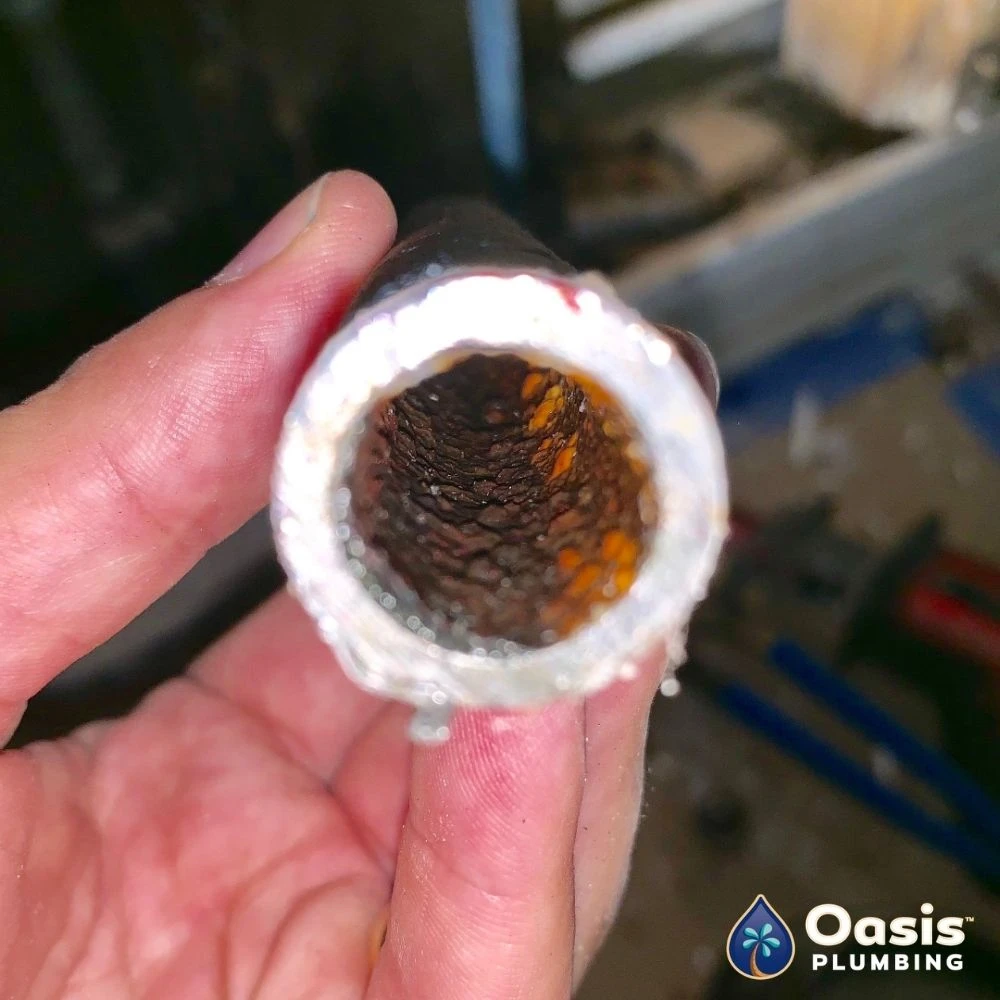
The important distinction is between the pipe’s physical size and its usable internal opening.
A pipe can remain the same size externally while the space available for water inside becomes smaller.
Could Your Water Line Be Restricted Inside?
If you suspect an older water-supply pipe has internal restrictions, call Oasis Plumbing at (305) 703-8220 to discuss an evaluation of the existing piping.
How Does Buildup Form Inside Galvanized Water Pipes?
Internal buildup develops when corrosion products form along the pipe’s inner surface and deposits accumulate within the water passage.
Galvanized steel pipes have a protective zinc coating. Where corrosion develops, reactions involving the metal can produce solid corrosion products.
Some of those products may remain attached to the interior surface.
As deposits accumulate, they can form uneven layers or rough areas that extend inward from the pipe wall.
The process can be understood in three basic stages.
Corrosion products develop along the inner surface
As corrosion occurs, solid material can form on or near the internal pipe wall. The amount and distribution of this material can vary from one section to another.
Deposits occupy part of the water passage
Corrosion products and accumulated material can extend into the opening where water normally flows. This reduces the space available for water movement.
The remaining passage becomes narrower or more irregular
As deposits develop, the internal opening may no longer have the same smooth, unobstructed shape. Water must move through the remaining space, which can increase resistance to flow.
This explanation describes what physically happens inside the pipe. It does not mean every galvanized water line will develop the same amount of restriction.
Why Can a Galvanized Pipe Look Normal Outside but Be Restricted Inside?
A galvanized pipe can retain its original exterior dimensions while corrosion products accumulate on its inner walls.
The outside of the pipe does not have to become noticeably larger or smaller for the internal opening to change.
Imagine looking at two pipes of the same original size. The first has a relatively open internal passage. The second has deposits extending inward from its walls.
From the outside, both pipes may appear similar. Inside, however, the second pipe has less room for water to travel.
That is the difference between outside diameter and usable internal diameter. The outside diameter describes the pipe’s external dimensions. The usable internal diameter describes the space through which water can actually pass.
Internal deposits can reduce that usable space without producing an obvious exterior change.
This is why an exterior visual inspection alone cannot reliably establish whether a galvanized pipe is internally restricted.
A pipe that appears relatively sound from the outside may still have deposits within its water passage.
Conversely, exterior discoloration does not establish how much internal buildup is present.
How Does a Smaller Galvanized Pipe Opening Affect Water Flow?
A smaller internal opening increases resistance to water movement and can limit the amount of water delivered through a pipe.
Water moving through a pipe experiences friction and other resistance along its path.
When deposits reduce the available opening, water must pass through a narrower space.
That can increase pressure loss along the restricted section, particularly when water demand increases.
For example, consider a pipe supplying water to a fixture. When the pipe’s internal passage is relatively open, water can move through it with less resistance. If buildup significantly narrows the passage, the same section may no longer deliver the same flow under comparable supply conditions.
The result can be reduced water delivery downstream of the restriction.
However, the actual effect depends on several factors, including:
How much of the internal opening is restricted.
The length of the affected section.
The shape and roughness of the remaining passage.
The amount of water being drawn through the line.
The pressure available to move water through the system.
A small amount of buildup does not necessarily produce a noticeable flow problem. More extensive restriction can have a greater effect.
The relationship is therefore not simply that any buildup automatically causes poor flow.
The degree and location of the restriction determine how much it affects water delivery.
Does Internal Buildup Reduce the Galvanized Pipe's Diameter Evenly?
Not necessarily. Deposits can accumulate unevenly, creating an irregular internal passage rather than a uniformly smaller opening.
It may be tempting to imagine buildup forming a smooth layer around the entire inside of a pipe.
In reality, corrosion products and deposits can form irregular surfaces. Some areas may have more accumulation than others. This means the remaining opening may be uneven or partially obstructed.
For example, one section may have a relatively open passage while another contains deposits extending farther into the water path. The resulting restriction may depend on the narrowest or most obstructed portions of the line.
This also explains why two galvanized pipes of the same original size may not deliver water equally.
Their external dimensions may match, but their internal conditions may be different.
Why Does the Shape of the Remaining Opening Matter?
A rough, irregular passage can create more resistance than a relatively smooth one.
Even when water can still pass through the pipe, deposits may disrupt the flow and increase friction along the affected section.
The effect becomes more significant when the buildup reduces the available opening enough to create a substantial restriction.
The physical condition of the interior therefore matters beyond the pipe’s nominal size.
Can One Section of Galvanized Pipe Have More Buildup Than Another?
Yes. Internal restriction can vary between different sections of galvanized piping within the same home.
The presence of buildup in one section does not establish that every connected pipe has the same internal condition.
For example, one branch may have a relatively open passage while another contains more extensive deposits. Even along a single water line, the amount of accumulation may differ between sections.
This variation matters because a restricted section can affect water delivery along the route it serves without producing identical effects throughout the plumbing system.
A home may therefore contain galvanized piping with different degrees of internal restriction. That does not automatically mean all of the piping is equally affected. It also means that observing a problem in one area is not enough to determine the internal condition of every other water line.
A plumbing evaluation needs to consider which sections may be involved and how they connect to the broader supply system.
Why Can a Short Restricted Galvanized Pipe Section Affect Water Delivery?
A relatively short section of pipe can contribute to reduced flow if its internal opening is sufficiently restricted.
The effect of buildup is not determined only by how much piping is affected. The severity of the restriction matters too.
Imagine a water line with several relatively open sections connected by one heavily narrowed portion. Water still has to pass through that restricted section to reach fixtures downstream. Even though most of the line may remain comparatively open, the narrow portion can create significant resistance.
This is similar to a passage that becomes constricted at one point. The available space elsewhere does not eliminate the restriction at that location.
However, the impact depends on the actual opening, the length of the restricted section, and the water demand.
A short section with minor deposits may have little noticeable effect. A short section with severe internal narrowing may create a more substantial limitation.
This is why the location and degree of buildup matter when evaluating an older water line.
Can Internal Buildup Cause Low Water Flow Without a Visible Leak?
Yes. Internal deposits can restrict water movement without creating an opening through the pipe wall.
A leak occurs when water escapes from the piping. An internal restriction is different. The pipe may continue containing water while deposits reduce the passage available for flow. As a result, a water line can deliver less water without showing an obvious external leak.
This distinction helps explain why the absence of visible leakage does not necessarily establish that a pipe is internally unobstructed.
However, low flow alone does not confirm galvanized pipe buildup. Other factors, such as fixture restrictions, partially closed valves, or problems within individual supply connections, can also affect water delivery.
The purpose of evaluating the water-supply system is to determine whether the limitation is actually within the piping.
Can Internal Deposits Break Loose From Galvanized Pipes?
Yes. Some corrosion products or accumulated material can become dislodged and travel with the water.
Not all deposits remain permanently attached to the pipe wall. Material that becomes loose may move downstream and collect at narrower fixture passages or faucet aerators.
This is different from deposits that remain attached and reduce the pipe’s internal opening.
Both involve material within the water-supply system, but they can create different observations.
Attached deposits can reduce the space available for water movement. Dislodged particles can travel through the system and collect at fixtures.
Finding particles at a faucet does not automatically establish where they originated or whether the supplying pipe has significant internal restriction.
For homeowners who notice reddish-brown debris at their fixtures, rust coming from your faucet explains how to distinguish a possible fixture-level source from material originating farther upstream.
How Can a Plumber Determine Whether Internal Buildup Is Restricting a Water Line?
A plumber can evaluate the water-supply system to determine whether reduced flow is consistent with a restriction in the piping or may have another cause.
Because internal buildup is not necessarily visible from the outside, the evaluation may need to consider more than the appearance of exposed pipes.
Depending on the plumbing configuration and available access, relevant considerations can include:
Which fixtures or branches are experiencing reduced flow.
Whether the limitation appears isolated or affects several connected fixtures.
The location of accessible pipe sections and connections.
Whether fixture-level restrictions or valves could explain the problem.
Which galvanized sections remain within the affected water path.
Whether further investigation is needed to establish the condition of a particular section.
These observations can help narrow down where a restriction may be located.
However, symptoms and exterior appearance alone cannot establish the exact amount of buildup inside a concealed pipe.
Additional evaluation may be necessary before the source and extent of the restriction can be confirmed.
If a restriction is traced to the water-supply piping, Oasis Plumbing’s water line repair and replacement service may be relevant to determining what work is appropriate.
Does Galvanized Pipe Buildup Mean the Entire Water Line Is Restricted?
No. Internal buildup does not necessarily affect every section of galvanized piping to the same degree.
Some sections may have substantial deposits while others remain relatively open.
A restriction may be concentrated along a particular length of pipe, at a connection, or within a branch. The extent cannot be established simply by knowing that the system contains galvanized steel.
This distinction matters when a homeowner is trying to understand whether a suspected restriction involves one section or a broader portion of the plumbing system.
If a plumber identifies significant internal restriction in one section, the surrounding piping may need to be evaluated to determine whether the problem is isolated.
For homeowners considering whether to replace one section of galvanized pipe, the condition of adjoining piping is an important part of determining whether a localized scope is reasonable.
In Shorecrest, homeowners concerned about older water-supply piping can also explore lead repiping and replacement in Shorecrest when an evaluation identifies deterioration that warrants discussing the affected sections.
The presence of internal buildup alone does not establish how much piping requires attention.
Suspect a Restriction Inside Your Water Line?
Call Oasis Plumbing at (305) 703-8220 to discuss an evaluation of your older water-supply piping and whether the restriction appears localized or more extensive.
Key Takeaways
Galvanized pipe buildup occurs when corrosion products and deposits accumulate inside galvanized steel water lines.
Deposits can reduce the usable internal opening without changing the pipe's exterior dimensions.
A narrower or more irregular passage increases resistance to water movement.
The effect on flow depends on the severity, length, and location of the restriction.
Buildup does not necessarily form evenly or affect every galvanized pipe to the same degree.
Internal restriction can occur without an obvious external leak.
Loose particles may travel toward fixtures, but their appearance does not establish the extent of internal buildup.
Reduced flow can have other causes, so the source should be evaluated before attributing the problem to galvanized piping.
A galvanized water pipe can look relatively normal from the outside while its internal passage becomes restricted.
As corrosion products and deposits accumulate along the inner walls, they can occupy space that would otherwise be available for water.
The resulting opening may become narrower, rougher, or more irregular, increasing resistance to flow. However, the degree of buildup can vary between different sections of piping.
One restricted section does not establish the condition of every water line in the home, and low flow does not automatically mean internal corrosion is responsible.
When galvanized pipe buildup is suspected, the important next step is determining where the restriction is located and how much of the existing supply system may be affected.
If your home has older galvanized water lines and you suspect internal buildup may be affecting water delivery, our plumbers in Miami Shores at Oasis Plumbing can help evaluate the existing water-supply system and discuss the appropriate next steps.
Call Oasis Plumbing at (305) 703-8220 to discuss your water-supply piping concerns in Miami-Dade.
