
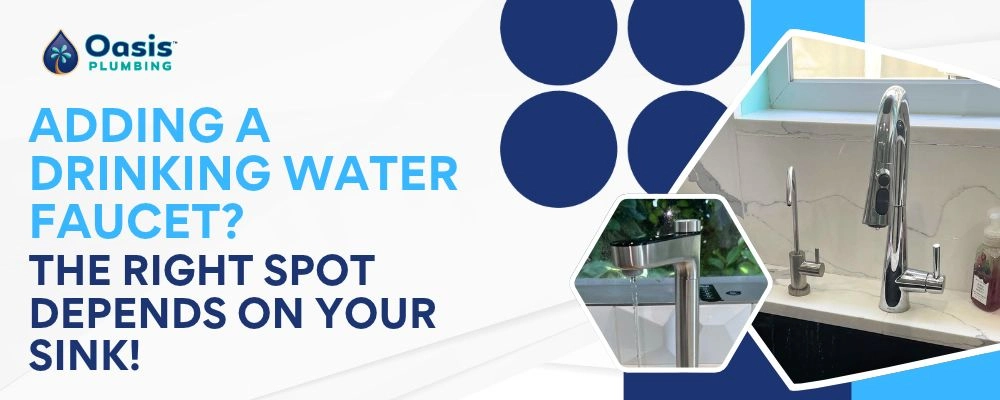
You’ve decided to install a reverse osmosis drinking water system in your kitchen. Now there’s another decision to make: where should the separate faucet go?
It might seem like a small detail, but the reverse osmosis faucet location can affect how comfortably you fill drinking glasses, water bottles, and larger containers every day.
The faucet also needs a suitable mounting surface, enough clearance for operation, and a practical connection to the filtration equipment beneath the sink.
For homeowners in Belle Meade, Miami, FL, choosing the right location means looking at the actual kitchen layout rather than assuming every sink supports the same arrangement.
A faucet that works well in one kitchen may be inconvenient or unsuitable in another.
Before installation, it’s worth understanding how sink configuration, countertop materials, available mounting space, and everyday drinking habits influence the decision.
Table of Contents
Where Should a Reverse Osmosis Faucet Be Installed?
A reverse osmosis faucet is typically installed near the kitchen sink, where it can be reached comfortably, dispense into the sink or a suitable container, and connect to the filtration system beneath the counter.
The best position depends on the existing sink and countertop. Some kitchens have an unused opening that may accommodate a compatible drinking water faucet. Others require a new mounting location to be evaluated.
A practical faucet position should allow you to:
Fill glasses and reusable water bottles comfortably.
Position containers beneath the spout.
Operate the faucet without interfering with nearby fixtures.
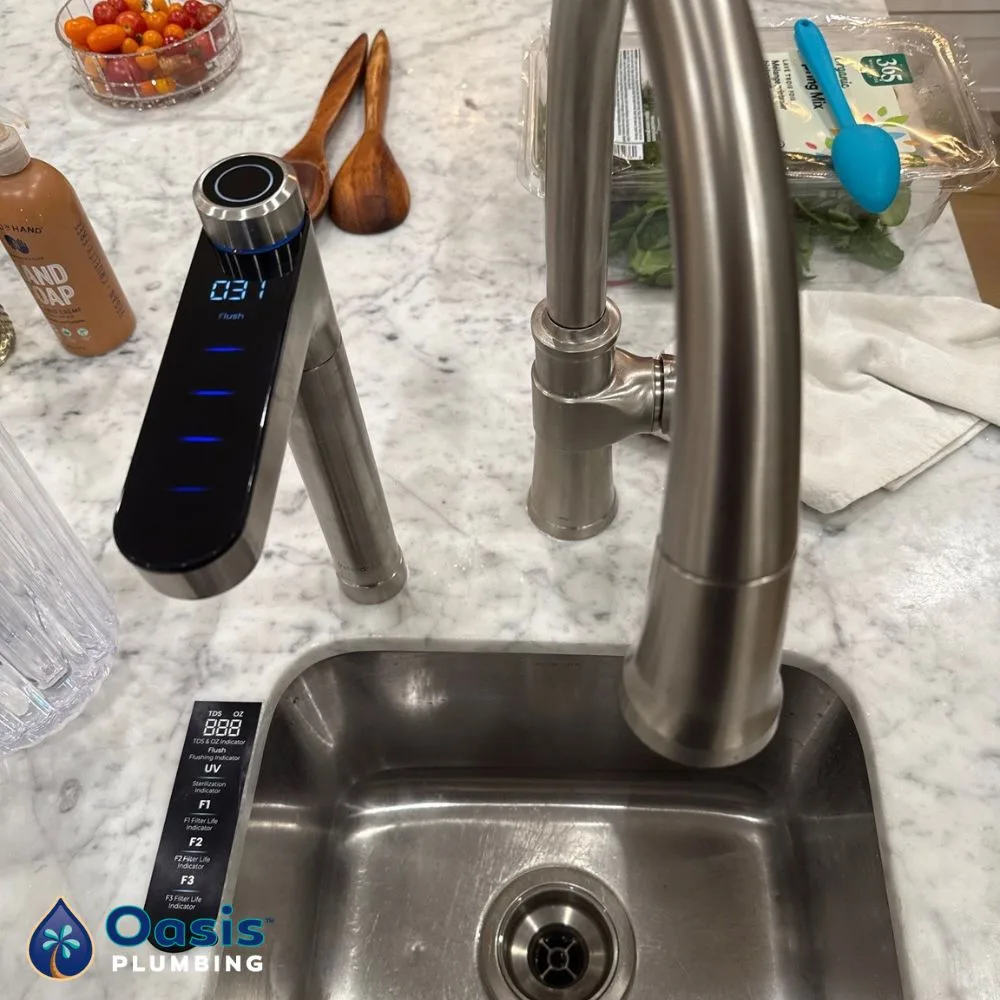
Reach the faucet without unnecessary stretching.
Maintain enough clearance around the sink.
Connect the faucet to the filtration equipment according to the manufacturer's requirements.
The most convenient location isn’t always the one that looks best in a photograph.
For example, a faucet positioned too close to the backsplash may be difficult to operate, even if it appears neatly aligned with the main kitchen faucet. Likewise, placing it too far from the sink may make filling containers less convenient.
The goal is to find a location that works with the kitchen rather than forcing the kitchen to accommodate a preferred position.
Planning a Reverse Osmosis Faucet Installation?
Call Oasis Plumbing at (305) 703-8220 to discuss a suitable drinking water faucet location for your Belle Meade kitchen.
How Does Your Kitchen Sink Configuration Affect Faucet Placement?
The shape, size, and configuration of your kitchen sink influence where a dedicated drinking water faucet can be installed and how comfortably it can be used.
A single-bowl sink may offer different placement possibilities from a double-bowl sink. The position of the main faucet, surrounding accessories, and available countertop space also affects the arrangement.
Single-Bowl Kitchen Sinks
With a single-bowl sink, homeowners may prefer a filtered-water faucet positioned near one side of the main faucet.
This can make it easy to place a glass or bottle beneath the spout while keeping the main sink available for other activities.
However, the location must still provide enough clearance between the fixtures. If the sink is close to a wall or backsplash, the space behind the sink may be limited.
A faucet with a lever or handle that requires additional movement may need more clearance than expected.
Double-Bowl Kitchen Sinks
Double-bowl sinks introduce another consideration: which bowl is most convenient for dispensing filtered water?
For example, one side may be used primarily for washing dishes, while the other is used for food preparation. Positioning the drinking-water faucet near the less frequently occupied bowl may make everyday use easier.
However, the ideal arrangement depends on the household’s routine. A faucet placed too far toward one bowl may also make it difficult to fill containers positioned elsewhere.
Undermount and Drop-In Sinks
The way the sink is installed can influence the available mounting surface.
An undermount sink sits beneath the countertop, while a drop-in sink typically has a visible rim resting on the counter. These configurations can create different clearances and mounting possibilities.
A drinking water faucet may be mounted through a suitable countertop opening or another approved mounting location, depending on the fixture and sink design.
The important point is that the mounting surface must be compatible with the faucet and provide enough space for its hardware.
Should the Reverse Osmosis Faucet Be Installed Next to the Main Kitchen Faucet?
Installing the reverse osmosis faucet beside the main kitchen faucet is a common arrangement, but it isn’t necessarily the best choice for every sink.
The advantage is convenience. Both water sources are accessible from approximately the same working area, making it easier to switch between regular tap water and filtered drinking water. However, the two faucets need enough space to operate independently.
Consider the Main Faucet's Movement
Some kitchen faucets have handles that move backward or sideways. Others feature pull-down spray heads or swiveling spouts. If the drinking-water faucet is installed too close, the fixtures may interfere with one another.
For example, a main faucet handle may strike the reverse osmosis faucet when moved into a particular position. The reverse can also happen if the drinking water faucet has a handle requiring clearance.
Before choosing a location, consider the full operating movement of both fixtures.
Should the Reverse Osmosis Faucet Go on the Left or Right?
There is no universally correct side. The best position depends on the household’s preferred working area, available mounting space, and nearby fixtures.
A right-handed homeowner may prefer one arrangement, while another household may find the opposite side more convenient. Rather than choosing a side based solely on appearance, consider where you naturally place a glass when using the sink.
A simple way to evaluate convenience is to imagine filling a water bottle while another person is using the main faucet. Would the two fixtures interfere with each other? If so, a different position may be more practical.
What About Sink Accessories?
Many kitchens already have a soap dispenser, air gap fitting, or other accessory near the main faucet. These components occupy valuable mounting space.
A new drinking water faucet should not obstruct an existing accessory or require relocating equipment without evaluating the implications. The final arrangement should allow each fixture to remain accessible and functional.
Why Does Faucet Reach Matter?
Faucet reach determines where water lands relative to the sink and how easily containers can be positioned beneath the spout.
A faucet may fit the available mounting space but still be awkward to use if its spout doesn’t extend far enough over the intended area.
For example, a drinking water faucet mounted near the back of a deep countertop may dispense water too close to the sink’s rear edge. This can make filling wider bottles or pitchers uncomfortable.
Spout Height and Container Clearance
Think about the containers your household uses most often. A short drinking glass may fit comfortably beneath almost any suitable faucet. A tall reusable bottle or pitcher may require more vertical clearance.
The faucet’s height and spout shape affect whether the container can be positioned beneath it without tilting. However, a taller faucet isn’t automatically more convenient. It also needs enough clearance from nearby cabinets, shelves, and other fixtures.
Swiveling vs. Fixed Spouts
Some drinking water faucets have spouts that can rotate, while others have more limited movement. A swiveling spout may make it easier to position water over a particular part of the sink.
However, the usefulness of that feature depends on the actual faucet model and mounting location. Homeowners should review the selected faucet’s specifications before assuming it can rotate or reach a particular area.
Avoiding Awkward Filling Positions
Imagine filling a large water bottle every morning. If the faucet is positioned where the bottle must be held at an angle, the arrangement may become inconvenient over time.
A better position would allow the bottle to sit naturally beneath the spout or be held comfortably. These small usability details are worth considering before a permanent mounting location is selected.
Can an Existing Sink Hole Be Used for a Reverse Osmosis Faucet?
An existing sink or countertop opening may be usable for a reverse osmosis faucet if its dimensions, mounting surface, and surrounding clearance are compatible with the selected fixture.
Some kitchens have unused openings that were originally intended for accessories. Using a suitable existing opening may avoid the need to create another one. However, an available hole is not automatically compatible with every drinking-water faucet.
What Needs to Be Checked?
Before using an existing opening, the installer should consider:
Hole diameter
Does it match the faucet manufacturer's mounting requirements?
Mounting surface thickness
Can the faucet be secured properly?
Clearance beneath the opening
Is there enough room for the mounting hardware and tubing?
Faucet orientation
Can the spout and handle operate without interference?
Usability
Does the location allow convenient filling of drinking containers?
An existing hole may satisfy the physical mounting requirements but still be poorly positioned for everyday use.
What If the Existing Hole Is Too Large?
A hole that exceeds the faucet’s specified mounting requirements may not provide proper support.
Some fixtures have compatible mounting accessories, but homeowners should not assume that any oversized opening can be adapted safely. The faucet manufacturer’s specifications and the actual mounting conditions should guide the decision.
Is an Existing Opening Always the Best Option?
No. An existing opening may be convenient, but it could position the faucet too close to another fixture or too far from the sink.
The decision should balance compatibility with usability. Avoiding countertop modification is useful only if the resulting faucet location works well.
How Does Countertop Material Affect Reverse Osmosis Faucet Placement?
Countertop material affects whether a new faucet opening can be created, how the mounting area should be evaluated, and what installation limitations may apply.
Not every countertop can be modified using the same approach. The material, thickness, condition, and proximity to edges or existing openings all matter. This is especially important when a kitchen does not already have a suitable faucet hole.
Granite and Other Natural Stone Countertops
Natural stone countertops require careful evaluation before modification. The location of a proposed opening may be affected by the stone’s condition, thickness, and proximity to other cutouts.
Creating an opening without appropriate equipment or expertise can risk damage. Homeowners should confirm whether qualified countertop work is necessary before approving a new mounting position.
Quartz and Engineered Stone
Engineered stone countertops also have specific fabrication requirements.
Although they may appear similar to natural stone, their composition and manufacturer instructions can differ. A new faucet opening should be evaluated based on the actual countertop material and its requirements.
The availability of suitable mounting space does not automatically mean modification is appropriate.
Laminate and Other Countertop Materials
Other countertop materials may present different installation considerations.
For example, a mounting area must provide adequate support for the faucet and remain suitable for a kitchen environment where water is regularly used. The condition of the material and the construction beneath it may affect suitability.
Why Should Drilling Be Evaluated Before Installation?
A faucet opening is a permanent modification. Before drilling or cutting, the installer needs to confirm that the proposed position is suitable and that the work can be performed appropriately.
Some installations may require a qualified countertop professional.
The decision to create a new opening should follow an assessment of the countertop—not simply a preference for where the faucet looks best.
How Does the Space Beneath the Sink Affect Faucet Location?
The space beneath the sink matters because the drinking water faucet must be secured from below and connected to the reverse osmosis equipment through an appropriate tubing route.
Even when a proposed location looks ideal from above, the area beneath it may contain obstacles. These can include the sink basin, drain piping, mounting brackets, cabinet structures, or existing plumbing connections.
A practical installation requires adequate space on both sides of the countertop.
Mounting Hardware Needs Clearance
Many drinking water faucets use mounting hardware beneath the sink or countertop. If the proposed opening is directly above an obstruction, the hardware may be difficult or impossible to secure properly.
For example, a faucet positioned close to an undermount sink’s attachment hardware may leave insufficient room for the mounting components. The installer should confirm the available clearance before selecting the final position.
Tubing Needs a Suitable Route
The faucet must connect to the reverse osmosis system through compatible tubing. The route should accommodate the manufacturer’s requirements without unnecessary strain, pinching, or interference with cabinet components.
A visually attractive faucet position may be impractical if the tubing cannot be routed appropriately. The installer should consider how the faucet connection will reach the filtration equipment while keeping the arrangement accessible.
Don't Forget Future Access
The faucet and its connections may need attention during future maintenance. A mounting position that is extremely difficult to reach from beneath the sink may create unnecessary complications.
This doesn’t mean the faucet must be positioned solely for maintenance convenience. However, accessibility should be part of the planning decision.
What Are Common Reverse Osmosis Faucet Placement Mistakes?
The most common placement mistakes involve choosing a location based on appearance without checking clearance, reach, mounting compatibility, and the space beneath the countertop.
A few examples illustrate why planning matters.
| Placement concern | Why it matters |
|---|---|
| Too close to the main faucet | Handles or spouts may interfere |
| Too close to the backsplash | Limited operating clearance |
| Too far from the sink | Awkward container filling or dispensing outside the bowl |
| Insufficient space beneath the opening | Mounting hardware or tubing may not fit |
| Incompatible existing hole | Faucet may not mount securely |
| Unverified countertop modification | Potential material damage or installation complications |
| Poor access for future maintenance | Connections may be difficult to reach |
Choosing a Position Only Because It Looks Symmetrical
A centered or evenly spaced arrangement may look appealing. However, symmetry does not guarantee that the faucet will be comfortable to use.
For example, a position that aligns neatly with the main faucet may interfere with its handle. Practical clearance should take priority over perfect visual alignment.
Ignoring How the Kitchen Is Actually Used
Some homeowners fill only drinking glasses. Others regularly fill large bottles, pitchers, or containers for preparing beverages. A suitable location should accommodate the household’s typical use.
Before approving the position, consider the size of the containers you expect to fill most often.
Assuming Every Sink Supports the Same Arrangement
Kitchen sinks vary widely in shape, mounting style, surrounding countertop space, and existing fixtures. A faucet location that works in one home may not be appropriate in another.
This is why the final placement should be based on the actual kitchen rather than a generic installation diagram.
What Should You Confirm Before Approving the Faucet Location?
Before approving a reverse osmosis faucet location, confirm that the proposed position is convenient to use, compatible with the faucet, and suitable for the existing sink, countertop, and under-sink connections.
A short discussion with the reverse osmosis installer can help avoid misunderstandings.
Consider asking:
Can the faucet reach the area where I normally fill drinking containers?
This helps establish whether the proposed position will be convenient.
Will the new faucet interfere with the main faucet or nearby accessories?
Check the operating clearance of all fixtures.
Can an existing opening be used?
Confirm compatibility rather than assuming a visible hole will work.
Will the countertop require drilling or modification?
Ask whether the material and proposed position are suitable.
Is there enough space beneath the countertop?
Mounting hardware and tubing need appropriate clearance.
Does the selected faucet have special mounting requirements?
Manufacturer specifications may affect the location.
Will the connections remain accessible?
Consider future maintenance and inspection needs.
These questions focus on the faucet itself rather than the broader selection of reverse osmosis equipment.
For Belle Meade homeowners planning a dedicated drinking water installation, the goal is to choose a position that works with the kitchen’s existing layout.
You can learn more about the local service on Oasis Plumbing’s reverse osmosis installation in Belle Meade page.
Need Help Planning Your Drinking Water Faucet?
Call Oasis Plumbing at (305) 703-8220 to discuss faucet placement and reverse osmosis installation considerations for your Belle Meade kitchen.
Key Takeaways
The best reverse osmosis faucet location depends on the actual sink, countertop, and kitchen layout.
A position beside the main faucet may be convenient, but adequate clearance is essential.
Faucet height, reach, and spout movement affect how easily drinking containers can be filled.
An existing sink opening may be usable if it meets the selected faucet's mounting requirements.
Countertop material and condition must be evaluated before creating a new opening.
Under-sink mounting clearance and tubing connections influence which positions are practical.
The most attractive location is not necessarily the most convenient or suitable.
A professional assessment can help identify practical placement options before installation begins.
The reverse osmosis drinking water faucet may be a small fixture, but its location affects how you use your kitchen every day. A well-planned position should make it comfortable to fill drinking glasses and bottles without interfering with the main faucet or surrounding accessories.
However, convenience is only part of the decision. The sink configuration, available mounting space, countertop material, and connections beneath the sink all influence what is possible.
For homeowners in Belle Meade, choosing a faucet location should begin with the actual kitchen arrangement rather than assuming a standard position will work. An existing opening may be suitable, or a different mounting location may need to be evaluated.
The right faucet position is one that combines everyday convenience with a suitable, properly supported installation.
Planning a reverse osmosis installation involves more than choosing a filtration system. The dedicated drinking water faucet also needs a practical location that fits your kitchen.
Our plumbers in Miami at Oasis Plumbing provides reverse osmosis installation services for homeowners in Belle Meade, Miami, FL.
When considering a dedicated drinking water faucet, important factors include your sink configuration, available mounting space, countertop material, and the connections required beneath the sink.
Oasis Plumbing can help you discuss your kitchen’s existing plumbing arrangement and evaluate suitable installation options based on the selected system’s requirements.
Not every sink supports the same faucet placement. An existing opening may be suitable, while another kitchen may require additional mounting considerations.
The goal is to choose an arrangement that works with your kitchen layout and supports convenient everyday use without assuming that countertop modifications are always possible or necessary.
Planning a reverse osmosis installation? Call Oasis Plumbing at (305) 703-8220 to discuss drinking-water faucet placement and installation options for your Belle Meade kitchen.
