
A plumber arrives to investigate a sewer line problem, but there’s an unexpected obstacle: the access point needed to evaluate the piping is nowhere to be found.
The sewer cleanout may be buried beneath soil, hidden by landscaping, covered by pavement, or located somewhere the homeowner has never noticed.
Without a suitable access point, the plumber may need to spend time establishing how to reach the sewer line before determining what’s happening inside it.
For homeowners in Shorecrest, Miami, FL, this can create an important distinction between two separate concerns: a problem with the sewer line and difficulty accessing it.
A buried or missing cleanout does not automatically mean the underground piping is damaged. However, limited access can affect how a plumber approaches the evaluation and what steps are practical.
Understanding the purpose of a cleanout, why it may be difficult to locate, and what happens when access is limited can help homeowners know what to expect before sewer line work begins.
Table of Contents
What Is a Sewer Cleanout, and Why Does It Matter?
A sewer cleanout is an access opening connected to drainage piping that allows a plumber to reach the system for certain cleaning, maintenance, or diagnostic procedures.
A typical cleanout includes a fitting with a removable, sealed cap or plug. Depending on the plumbing layout, it may be located outdoors, near the building, or at another accessible point along the drainage system.
The purpose is straightforward: provide a designated opening into the piping without having to disconnect unrelated plumbing components.
When a suitable cleanout is available, a plumber may be able to introduce appropriate equipment into the sewer line.
However, having a cleanout does not guarantee access to every section of the system. Its location, orientation, size, and condition affect what can be reached.
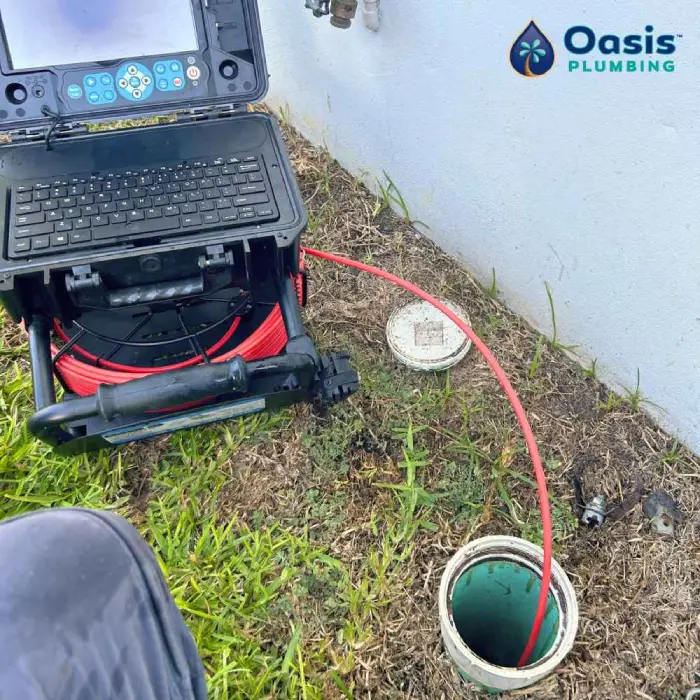
What Does a Sewer Cleanout Look Like?
Cleanouts vary by installation.
An outdoor cleanout may appear as a capped pipe near ground level. The cap may be threaded or use another approved closure design. Some cleanouts are installed within access boxes, while others are positioned near walls or other parts of the property’s drainage system.
The appearance depends on the pipe material, installation, and surrounding conditions. Not every visible capped pipe is necessarily the correct access point for the sewer section being evaluated. A plumber must identify the appropriate connection before using it.
Why Is the Cleanout Important During Sewer Line Work?
The cleanout provides a planned route into the drainage system. Without a suitable opening, reaching the affected section may become more complicated.
For example, a plumber investigating a suspected sewer obstruction may need equipment to enter the piping from an appropriate direction.
If the intended cleanout is inaccessible, the plumber must determine whether another suitable opening exists or whether access needs to be established.
This is why locating the cleanout can be an important preliminary step rather than a minor detail.
Having Trouble Accessing Your Sewer Line?
Call Oasis Plumbing at (305) 703-8220 to discuss sewer line concerns and difficult cleanout access at your Shorecrest property.
Why Would a Sewer Cleanout Be Buried or Difficult to Find?
A sewer cleanout may be difficult to locate because its original position is no longer visible, landscaping or property improvements obstruct access, or the homeowner does not know where it was installed.
The difficulty does not necessarily involve the condition of the underground sewer pipe. Sometimes, the access point is present but concealed. In other situations, the expected access location may not have a usable cleanout.
Soil, Mulch, and Landscaping
A cleanout installed near ground level can become less visible when surrounding conditions change.
For example, additional soil or mulch may cover the cap. Plants, decorative stones, or landscaping materials can also make the access point difficult to recognize. A homeowner may walk past the cleanout regularly without realizing it is there.
The important distinction is that an obstructed access point may still be structurally usable once it is properly located and exposed.
Driveways, Patios, and Other Property Improvements
Changes to a property can affect access to existing plumbing components.
A patio, walkway, driveway, or other improvement may cover an area where a cleanout was previously accessible.
However, the presence of pavement does not establish that a cleanout is buried beneath it. The actual location must be determined before assuming that a particular surface needs to be disturbed.
For Shorecrest homeowners considering exterior improvements, preserving access to known plumbing components can help avoid future complications.
Previous Plumbing Changes
A property’s drainage system may have undergone alterations over time. Piping may have been rerouted, replaced, or connected differently during previous work. These changes can make older information about cleanout locations less useful.
A homeowner may also be unfamiliar with work completed before purchasing the property. Without reliable documentation, locating the correct access point can require additional evaluation.
A Cleanout That Was Never Easily Accessible
Some properties may not have a readily accessible cleanout in the location a plumber would normally expect. The installation may reflect an older configuration or a different plumbing layout.
Whether additional access is required depends on the existing system and applicable requirements. The absence of a visible exterior cleanout does not establish that no cleanout exists anywhere on the property.
Does a Missing or Buried Sewer Cleanout Mean the Sewer Line Is Damaged?
No. A missing, buried, or inaccessible sewer cleanout does not independently indicate that the sewer pipe is cracked, blocked, collapsed, or otherwise damaged.
The cleanout is an access component. The sewer line is the piping that carries wastewater away from the building. Although they are connected, a problem locating the cleanout is not the same as identifying a defect in the sewer line.
For example, a cleanout could be completely functional but hidden beneath landscaping. Alternatively, a cleanout could be visible while the sewer pipe itself has a separate problem. The two conditions need to be evaluated independently.
Access Problems vs. Sewer Line Problems
| Situation | What it may indicate | What it does not prove |
|---|---|---|
| Cleanout covered by soil | Access may be concealed | The sewer pipe is damaged |
| Cleanout blocked by landscaping | The opening may be difficult to reach | Wastewater flow is restricted |
| Cleanout location unknown | More information may be needed | No cleanout exists |
| Cleanout cap cannot be removed | The access component may need attention | The entire sewer line needs repair |
| No suitable access point available | Another access strategy may be required | The underground pipe has failed |
This distinction matters because the next step should address the actual obstacle. If the only confirmed problem is access, the plumber should not assume that sewer line repair is necessary.
If the homeowner is also experiencing drainage problems, suitable access may be needed before the cause can be evaluated.
Can a Cleanout Have Its Own Problems?
Yes. A cleanout cap, fitting, or surrounding connection may be damaged or difficult to operate.
For example, a cap may be seized, deteriorated, or improperly sealed. These conditions can affect access even when the rest of the sewer line has not been evaluated.
A damaged cleanout component should not automatically be treated as evidence of widespread sewer pipe damage.
How Does Difficult Sewer Cleanout Access Affect Sewer Line Diagnosis?
Difficult cleanout access can delay or limit a plumber’s ability to reach the sewer section that needs evaluation.
The main challenge is not necessarily a lack of diagnostic equipment. It is whether that equipment can enter the appropriate portion of the piping safely and effectively.
A plumber may need to determine which access point provides a suitable route toward the suspected problem. If the intended opening is buried or obstructed, that decision becomes more complicated.
Why Does the Entry Point Matter?
Sewer piping follows a particular route through the property.
A sewer cleanout may provide access in one direction, both directions, or only to certain connected sections, depending on its configuration. This means two access points on the same property may not offer equivalent access.
For example, a cleanout located upstream of the suspected problem may provide a different route from one positioned downstream. The plumber must consider which opening is suitable for the intended work.
Can a Plumber Evaluate the Sewer Line Without the Original Cleanout?
Sometimes. Another suitable access point may be available, depending on the plumbing configuration and the procedure being considered.
However, not every drain opening is appropriate for every diagnostic or cleaning tool. Using an unsuitable opening may create additional risks or fail to provide access to the relevant pipe section.
A plumber should assess the available options rather than assume that any nearby drain can serve as a substitute.
What If the Available Opening Doesn't Reach the Problem Area?
The plumber may need to establish another suitable route.
For example, an existing opening might provide access to one branch of the drainage system but not the section suspected of having a problem. In that case, the limitation should be explained before proceeding.
The homeowner should understand whether the obstacle is the condition of the sewer pipe or the inability to reach the intended area. This keeps the evaluation focused on the information that is actually available.
How Might a Plumber Locate a Buried Sewer Cleanout?
A plumber may begin by reviewing available information about the property’s drainage layout, examining likely access areas, and determining whether professional locating methods are appropriate.
The exact approach depends on the property and what is already known. There is no single location where every home’s sewer cleanout must be found.
A sewer cleanout may be positioned near the building, along the sewer route, or at another point specified by the installation.
Reviewing Available Plumbing Information
Existing plumbing records, drawings, or information from previous service work may help identify where a cleanout was installed.
However, older records may not reflect subsequent modifications. They can provide useful clues without necessarily establishing the current location.
If a homeowner has documentation from previous plumbing work, sharing it with the plumber may help narrow down the search.
Looking for Accessible Plumbing Features
A professional may examine visible plumbing features and consider how the drainage system is likely arranged.
For example, the location of accessible cleanouts or other relevant components may help inform the evaluation.
However, the apparent route of piping should not be treated as proof of the exact underground layout. Concealed plumbing can differ from what is visible above ground.
Considering Professional Locating Methods
When the cleanout remains difficult to locate, specialized locating methods may be considered where suitable.
The availability and usefulness of those methods depend on the piping, existing access, and the equipment involved. Not every locating method works under every condition.
A professional should determine which approach is appropriate rather than assuming that the cleanout can always be found from the surface.
Why Guessing Can Create Problems
Randomly disturbing landscaping or paved surfaces in search of a cleanout can create unnecessary damage. It may also expose unrelated utilities or plumbing components.
Homeowners should avoid digging or cutting into surfaces based only on an assumed cleanout location. When access is uncertain, professional evaluation is the safer approach.
What Happens If the Sewer Cleanout Is Found but Cannot Be Used?
If a cleanout is located but cannot be opened or used safely, the plumber must determine whether the access problem can be addressed or whether another suitable opening is necessary.
Finding the cleanout is not always the end of the access problem. The cap may be difficult to remove. The fitting may be damaged. The opening may also be positioned in a way that limits the intended work. These conditions require different decisions.
A Stuck or Damaged Sewer Cleanout Cap
A cap may become difficult to remove because of age, deterioration, previous installation conditions, or other factors. Applying excessive force can damage the fitting or connected piping.
A plumber should assess the condition before attempting removal. If the component is damaged, corrective work may be needed to restore usable access. That does not automatically mean the underground sewer line requires repair.
An Opening That Is Physically Obstructed
Even when a cleanout is visible, surrounding structures or stored items may prevent suitable access.
For example, a cleanout positioned too close to an obstruction may not provide enough working space for the intended equipment.
The plumber may need to consider whether the obstruction can be safely addressed or whether another access point is more appropriate.
A Sewer Cleanout That Doesn't Serve the Needed Section
A usable sewer cleanout may connect to a different portion of the drainage system than the one requiring evaluation. This is another reason locating a capped pipe is not enough.
The professional must confirm that the opening is appropriate for the work. Access is useful only when it provides a suitable route to the relevant plumbing section.
What If No Suitable Sewer Line Access Is Available?
When no suitable access point is available, a plumber may need to consider alternative existing openings or whether establishing additional access is appropriate.
The decision depends on the property’s plumbing layout, the suspected problem, and the work that needs to be performed. This does not mean extensive excavation is automatically required.
It also does not mean the sewer line itself is defective. The immediate concern may simply be that the system cannot be reached through an appropriate opening.
Can Another Existing Access Point Be Used?
Possibly. A property may have more than one sewer cleanout or another access arrangement that is suitable for the intended work.
However, suitability must be established. The size, direction, and location of an opening affect what equipment can be used and which piping can be reached. The plumber should explain why a particular access point is being considered.
Could Additional Access Be Necessary?
In some situations, establishing a new or improved access point may be considered.
Whether this is appropriate depends on the plumbing configuration, applicable requirements, and the condition of the existing system. The homeowner should understand the reason for the proposed access work.
For example, creating access to evaluate a suspected sewer problem is different from repairing a confirmed defect in the sewer pipe. These activities should not be presented as interchangeable.
Should Access Work Be Approved Before the Sewer Problem Is Confirmed?
Sometimes, access-related work may be necessary before a complete evaluation can be performed.
However, the plumber should explain what is known, what remains uncertain, and what the access work is intended to accomplish.
Homeowners should understand whether they are approving work to establish access, work to evaluate the piping, or a confirmed sewer line repair. Keeping those stages clear can prevent misunderstandings about the proposed scope.
What Should Shorecrest Homeowners Ask Before Approving Access-Related Work?
Before approving work related to a buried or inaccessible cleanout, homeowners should understand what access problem has been identified, what the plumber proposes to do, and whether the sewer line condition is still unknown.
A clear explanation helps distinguish necessary access work from repairs that may or may not be required afterward.
Useful questions include:
Has the cleanout been located, or is its position still uncertain?
This clarifies whether the immediate task involves locating an opening or making an identified opening usable.
Is the existing cleanout suitable for the intended evaluation?
A visible opening may not provide access to the relevant section.
Are there other usable access points?
Ask whether an existing alternative is appropriate before considering additional work.
What areas of the property could be affected?
Clarify whether landscaping, pavement, or another surface may need to be disturbed.
What will establishing access allow the plumber to determine?
Understand the purpose of the proposed work and what information it may provide.
Is sewer line damage already confirmed?
Make sure the distinction between suspected pipe problems and access limitations is clear.
What happens if additional work is recommended afterward?
Ask how new findings and proposed changes will be communicated.
These questions are especially relevant when a homeowner is dealing with a drainage concern but the affected sewer section has not yet been reached.
For information about the service available in the neighborhood, see Oasis Plumbing’s sewer line repair in Shorecrest page.
The broader sewer line repair and replacement page also provides information about the service when sewer line defects are identified.
The goal is not to assume repairs are necessary. It is to establish the information needed to determine the appropriate next step.
Need to Discuss Sewer Line Access?
Call Oasis Plumbing at (305) 703-8220 to discuss difficult cleanout access and the next steps for evaluating a sewer line concern in Shorecrest.
Key Takeaways
A sewer cleanout provides a designated opening for accessing portions of the drainage system.
Soil, landscaping, pavement, property alterations, and unfamiliar plumbing layouts can make a cleanout difficult to locate.
A buried or missing cleanout does not prove that the underground sewer pipe is damaged.
The location and configuration of an access point determine which piping can be reached.
A visible cleanout may still be unusable because of a damaged cap, obstruction, or unsuitable configuration.
Plumbers may consider existing access points, available records, and appropriate locating methods before recommending additional access work.
Establishing suitable access and repairing a damaged sewer line are separate decisions.
Homeowners should understand what is known about the sewer problem before approving access-related or repair work.
A sewer line problem can be difficult to evaluate when the sewer cleanout is buried, obstructed, or impossible to locate.
The challenge may involve finding the correct opening, making an existing cleanout usable, or determining whether another access point is appropriate. However, difficult access should not be confused with evidence of sewer line damage.
A sewer cleanout hidden beneath landscaping does not establish that the pipe is cracked. Likewise, a missing exterior access point does not automatically mean the sewer line needs replacement.
For Shorecrest homeowners, the practical first step is understanding whether the plumber has a suitable route into the affected piping.
Once appropriate access is established, the plumber may be better positioned to evaluate the suspected problem and determine whether further work is necessary.
The condition of the sewer line should guide repair recommendations—not the difficulty of locating its cleanout.
A buried or obstructed sewer cleanout can make an existing sewer line problem more difficult to evaluate.
If you’re experiencing drainage concerns at your Shorecrest home but the cleanout cannot be located or accessed, understanding the available access options is an important part of determining what should happen next.
Our plumbers in Miami at Oasis Plumbing provide sewer line evaluation and repair services for homeowners in Shorecrest, Miami, FL.
When access is difficult, the first consideration is whether the existing plumbing arrangement provides a suitable way to reach the affected section.
Depending on the property, a plumber may need to evaluate the available access points and determine what additional steps are appropriate before the sewer line can be assessed.
A buried, obstructed, or missing cleanout does not automatically mean the sewer line is damaged. Establishing suitable access helps separate the access problem from any underlying pipe condition.
Once the sewer line can be appropriately evaluated, the findings can help determine whether repairs are necessary.
Oasis Plumbing can discuss your sewer line concerns and the next steps for professional evaluation. Specific cleanout-locating or access-establishment work should be confirmed based on the property’s needs and available service scope.
Experiencing sewer problems with difficult cleanout access? Call Oasis Plumbing at (305) 703-8220 to discuss sewer line evaluation and repair in Shorecrest.
