

Not every drainage system problem is easy to locate. Pipes may run behind walls, beneath floors, or underground, making it difficult to identify where an unintended opening exists.
Even when a plumber suspects that something is wrong, the exact location may not be immediately apparent.
A sewer smoke test is one diagnostic method that can help locate certain openings in a building’s drainage and vent system. By introducing visible, purpose-made testing smoke into the piping, plumbers can observe where it escapes and identify areas that may require further investigation.
However, seeing smoke emerge from a particular location does not automatically reveal what caused the opening or whether the underground sewer line is damaged.
A smoke test can provide valuable clues, but its findings must be interpreted in context.
Understanding how the test works, what it can reveal, and where its limitations begin can help homeowners make sense of the results before plumbing repairs are recommended.
Table of Contents
What Is a Sewer Smoke Test?
A sewer smoke test is a diagnostic procedure that introduces visible testing smoke into a drainage or vent system to help identify openings where air or sewer gases may escape.
Residential drainage systems contain pipes that carry wastewater and vent piping that allows air to move through the system.
These components are intended to function together while maintaining appropriate separation between sewer gases and occupied areas of the home.
However, damaged connections, unintended openings, or other defects may create pathways that allow air to escape where it should not. Smoke testing helps make some of those pathways visible.
During the procedure, a plumbing professional introduces testing smoke into an appropriate part of the system and observes where it appears.
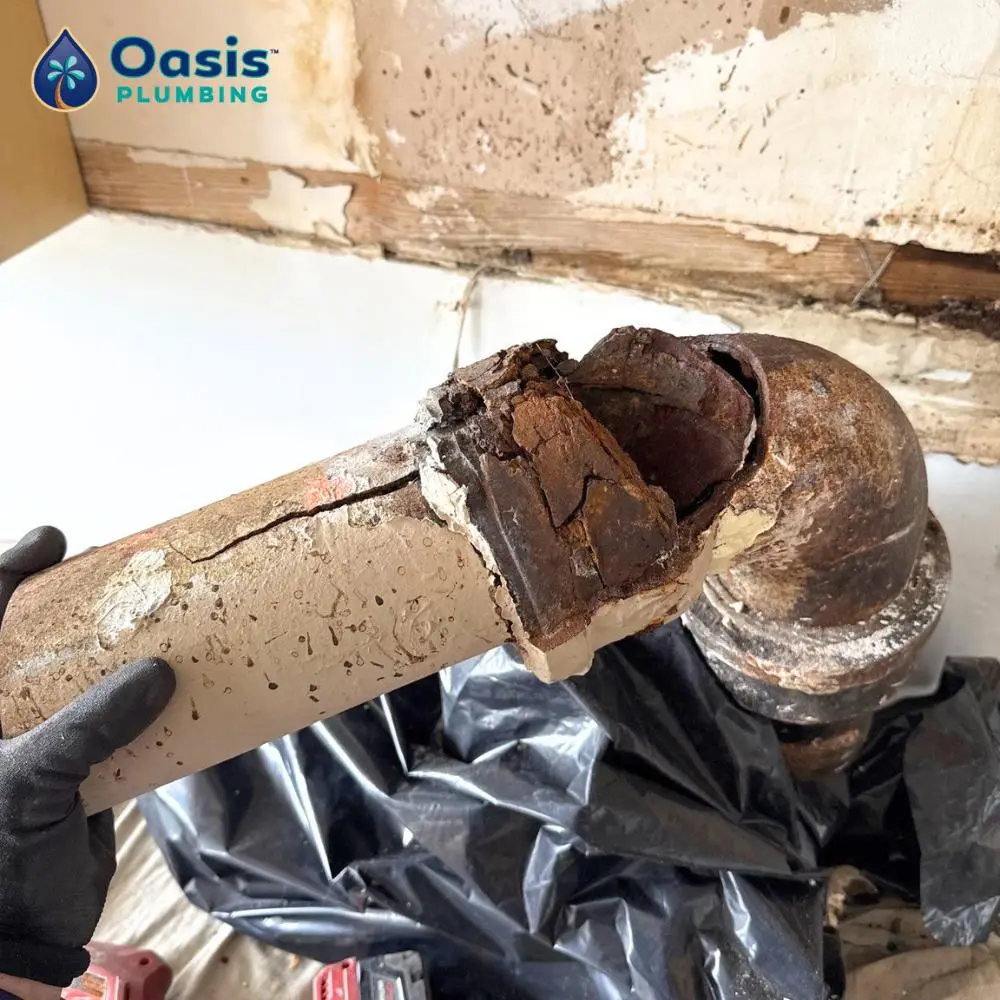
If smoke emerges from an unexpected location, that observation may help narrow down the area requiring further evaluation.
Is Sewer Smoke Testing the Same as a Camera Inspection?
No. Smoke testing and camera inspections provide different types of information.
A sewer camera allows a plumber to examine visible interior pipe conditions, such as certain cracks, obstructions, or damaged joints.
Smoke testing focuses on identifying pathways through which introduced smoke can travel and escape.
For example, a camera may show a visible defect inside a pipe, while smoke testing may help locate an unintended opening that connects the drainage system to another area. Neither method independently establishes every possible plumbing condition.
The appropriate diagnostic approach depends on the suspected problem and the information needed.
Concerned About a Hidden Drainage System Problem?
Locating an unintended opening can help determine whether further plumbing evaluation is needed. Call Oasis Plumbing at (305) 703-8220 to discuss your concerns.
How Does a Sewer Smoke Test Work?
During a sewer smoke test, a plumbing professional introduces visible testing smoke into a drainage or vent system and observes where the smoke travels or escapes.
The purpose is to identify pathways that may not be visible during an ordinary examination of the property.
A specialized smoke-producing device may be connected to a suitable access point, depending on the plumbing system and the area being evaluated. The testing smoke is then moved through the piping under controlled conditions.
Because the smoke is visible, it can help reveal openings that allow air to pass between the drainage system and other spaces.
How Is Smoke Introduced Into the Plumbing System?
The specific setup depends on the property and the diagnostic objective.
A plumber may use an appropriate access point to introduce testing smoke into the drainage or vent piping. The smoke is then distributed through the connected portions of the system that are accessible under the test conditions.
The professional observes where smoke appears and considers whether those locations are expected or unexpected. This is not a procedure homeowners should attempt using household smoke-producing materials.
Professional testing requires suitable equipment, appropriate preparation, and an understanding of how the drainage and vent system is connected.
Where Should Smoke Normally Travel?
In a functioning drainage and vent system, smoke may travel through connected piping and exit through intended openings, such as a plumbing vent terminal.
Seeing smoke at an appropriate vent outlet is not automatically evidence of a defect. The purpose of the test is to distinguish expected smoke movement from smoke escaping through an unintended pathway.
For example, smoke emerging from a roof vent may be consistent with the system’s intended design. Smoke appearing from an unexpected opening inside a building may warrant further investigation.
The significance of smoke depends on where it appears and whether that location is part of the intended plumbing system.
What Types of Hidden Plumbing Problems Can Smoke Testing Reveal?
A sewer smoke test can help identify certain unintended openings in drainage and vent piping, including compromised connections, defective seals, or other pathways through which smoke can escape.
The test is particularly useful when the suspected problem involves a possible opening between the plumbing system and another area.
However, the appearance of smoke is an observation rather than a complete diagnosis. Several different conditions can produce similar results.
Openings in Drainage or Vent Pipes
A damaged section of piping may allow smoke to escape.
For example, an opening in a concealed drain or vent pipe could create a pathway between the plumbing system and a nearby wall cavity. If smoke reaches an accessible area through that opening, it may help the plumber narrow down the location of the problem.
However, smoke appearing nearby does not necessarily identify the exact point where the pipe is damaged. It may have traveled through another concealed space before becoming visible.
Compromised Pipe Connections
Drainage and vent systems contain connections between different sections of piping.
If a connection is not properly sealed, it may allow smoke to escape under testing conditions. The resulting smoke pattern can help identify an area requiring closer examination.
However, the test alone may not establish whether the connection is separated, deteriorated, incorrectly installed, or affected by another condition.
Defective Fixture Seals or Connections
Some unintended smoke pathways may involve plumbing fixtures rather than the underground sewer line.
For example, a compromised toilet seal may provide a pathway for smoke to appear near the base of the fixture. Similarly, certain defective connections may allow smoke to enter areas where it should not.
These findings are important because an unexpected smoke release does not automatically mean the main sewer pipe is damaged. The source may involve a component elsewhere in the drainage system.
Open or Improperly Sealed Drainage Connections
An open or improperly sealed connection may also allow testing smoke to escape.
In some circumstances, an unused or disconnected portion of the drainage system may create an unintended pathway. A smoke test may help reveal that pathway, but additional evaluation may be needed to establish why it exists.
The important distinction is that smoke testing identifies where smoke can travel, not necessarily what caused the opening.
Why Does Smoke Escape Through Plumbing Defects?
Smoke escapes when an opening provides a pathway from the tested drainage or vent system to another location, and the test conditions allow smoke to move through that pathway.
Drainage and vent piping is intended to contain wastewater and direct air movement through appropriate routes. When an unintended opening exists, smoke introduced during testing may pass through it. The smoke can then become visible at another location.
For example, consider a hypothetical vent pipe concealed behind a wall. If the pipe has an opening, testing smoke may escape into the surrounding wall cavity. Depending on the construction and available pathways, the smoke might eventually appear around a nearby penetration or gap.
The visible smoke location may help identify the general area of concern, but it may not coincide exactly with the pipe defect.
Does Visible Smoke Always Mean the Pipe Is Cracked?
No. A crack is one possible explanation, but smoke may also escape through a compromised joint, defective seal, open connection, or another unintended pathway.
The appearance of smoke establishes that a pathway was available under the test conditions. It does not automatically identify the type of defect.
This distinction helps prevent homeowners from assuming that every smoke-testing result indicates a broken sewer pipe.
Can Smoke Travel Before Becoming Visible?
Yes. Smoke may move through concealed spaces before appearing somewhere a plumber can observe it.
For example, smoke escaping from a pipe inside a wall cavity may travel through gaps around framing or other openings.
The location where smoke becomes visible may therefore differ from the actual defect location.
This is one reason plumbers must interpret smoke-testing observations rather than treating every visible smoke plume as the precise source.
How Do Plumbers Interpret Where Smoke Appears?
Plumbers interpret smoke testing results by considering where smoke emerges, how that location connects to the drainage system, and whether the observed pathway is expected.
The test is most useful when the smoke pattern can be connected to the plumbing layout and the suspected problem.
For example, smoke emerging from an intended vent outlet may be normal. Smoke appearing near an unexpected interior opening may suggest a defect or an unintended connection.
However, the same visible location may have more than one possible explanation.
What Does Smoke Appearing Indoors Suggest?
Smoke appearing unexpectedly inside a home may indicate a pathway between the tested plumbing system and an occupied or concealed space.
Possible explanations include a defective fixture seal, compromised piping, or another opening. The observation helps identify an area of concern. It does not necessarily establish which component is responsible.
A plumber may need to consider the nearby fixtures, pipe connections, and building layout before drawing a conclusion.
What If Smoke Appears Outdoors?
Outdoor smoke may emerge from intended plumbing vents or other accessible openings.
In some situations, smoke appearing from an unexpected outdoor location may warrant investigation. However, outdoor smoke alone does not establish that an underground sewer line is cracked.
The professional must determine whether the observed release is consistent with the system’s intended design or suggests an unintended pathway.
Does More Smoke Mean More Severe Damage?
Not necessarily. The amount of visible smoke can be influenced by the opening, test conditions, airflow, and the route through which smoke travels.
A large visible plume does not automatically establish a large pipe defect. Similarly, a small amount of smoke does not necessarily mean the underlying condition is insignificant.
The amount of smoke should not be used as a direct measurement of damage severity.
What Can a Sewer Smoke Test Confirm—and What Can't It?
A sewer smoke test can demonstrate that smoke traveled through a particular pathway under the test conditions, but it cannot independently establish every detail about the pipe’s condition or the cause of the opening.
This is one of the most important limitations for homeowners to understand. A test result may identify a location where smoke unexpectedly appears.
However, additional information may be necessary to determine which plumbing component is affected and why the pathway exists.
| What smoke testing may reveal | What it does not automatically establish |
|---|---|
| Smoke escaping from an unexpected location | The exact type of plumbing defect |
| A possible opening in drainage or vent piping | The full extent of structural damage |
| An unintended pathway near a plumbing fixture | That the underground sewer line is damaged |
| A general area requiring investigation | The precise defect location inside a concealed space |
| A pathway through which smoke can travel | That every possible opening has been identified |
Can a Smoke Test Detect Every Sewer Line Crack?
No. Not every crack will produce a visible smoke release. Some defects may be submerged, inaccessible to the introduced smoke, or otherwise difficult to identify under the test conditions.
The visibility of smoke also depends on where it can escape and whether that location can be observed. A crack may exist without creating a visible plume.
Therefore, the absence of unexpected smoke does not prove that every section of the sewer line is structurally sound.
Can Smoke Testing Determine Whether a Pipe Is Blocked?
Smoke testing is not primarily designed to identify ordinary internal obstructions.
A blockage may affect smoke movement, but the test does not provide the same information as examining the pipe’s interior.
If the main concern is an obstruction restricting wastewater flow, another diagnostic approach may be more appropriate.
Does a Successful Smoke Test Rule Out All Plumbing Problems?
No. A smoke test can provide useful evidence about the pathways evaluated under the test conditions.
However, it cannot rule out every concealed defect, drainage obstruction, or structural condition. The absence of unexpected smoke should be interpreted within the limitations of the test.
A smoke test is a targeted diagnostic tool, not a complete assessment of every component in the sewer system.
When Is Sewer Smoke Testing Useful?
Sewer smoke testing is useful when a plumber needs to investigate a suspected unintended opening or air pathway within a drainage or vent system.
It can be particularly valuable when the suspected opening is concealed or difficult to locate through ordinary observation.
For example, a plumber may suspect that air is escaping from a drainage or vent connection hidden behind a finished surface.
A smoke test may help narrow down where that pathway exists.
However, the method should match the question being investigated.
When Might Smoke Testing Be Appropriate?
Situations where smoke testing may provide useful information include:
Suspected openings in concealed drainage or vent piping.
Possible defective seals or connections near plumbing fixtures.
Unexplained pathways between the drainage system and interior spaces.
Questions about whether a drainage or vent connection is properly sealed.
Attempts to narrow down an area where an unintended opening may exist.
These situations do not automatically require smoke testing. The plumber must determine whether the method is appropriate for the suspected condition.
When Might Another Diagnostic Method Be More Useful?
If the concern involves a visible obstruction, internal pipe damage, or the alignment of an underground sewer line, another evaluation method may provide more relevant information.
For example, a sewer camera may help examine accessible interior pipe surfaces. Other diagnostic approaches may be needed when the question concerns conditions that smoke testing cannot establish.
The goal is not to use every available test. It is to select the method that can provide useful information about the suspected problem.
Why Might Further Investigation Be Needed After a Smoke Test?
Further investigation may be needed when smoke testing identifies an unexpected pathway but does not establish the exact defect, its extent, or the corrective work required.
Finding where smoke appears can be an important step. However, a repair recommendation should address the actual plumbing condition, not merely the visible smoke.
Consider a hypothetical situation where smoke appears near a bathroom wall. That observation may suggest an unintended pathway connected to the drainage or vent system.
However, the actual opening could be located within the wall, near a fixture connection, or elsewhere along the connected piping. Additional evaluation may be necessary to determine which component is affected.
What Questions Should the Findings Help Answer?
After an unexpected smoke release is observed, a plumber may need to establish:
Which drainage or vent component is involved.
Whether the opening is intentional or unintended.
Whether a defective seal, connection, or pipe section is responsible.
Whether the visible smoke location matches the actual defect location.
Whether additional concealed conditions need evaluation.
What corrective work, if any, is appropriate.
These questions help turn a diagnostic observation into a more informed recommendation.
Does Finding an Opening Automatically Mean Sewer Line Repair Is Needed?
No. An unintended opening may involve a fixture seal, vent connection, drain fitting, or another plumbing component. Not every finding requires work on the underground sewer line.
The affected component must be identified before the appropriate corrective work can be determined. If the evaluation establishes a defect involving sewer piping, Oasis Plumbing’s sewer line repair and replacement service provides information about addressing sewer-line problems.
For homeowners in Belle Meade, additional location-specific information is available on the sewer line repair in Belle Meade page.
The important principle is that the recommended work should follow the findings, not assumptions about what the smoke test must have revealed.
Need Help Identifying a Drainage System Problem?
Smoke testing may help locate an unintended opening, but further evaluation may be necessary to determine the cause. Call Oasis Plumbing at (305) 703-8220 to discuss your plumbing concerns.
Key Takeaways
A sewer smoke test introduces visible testing smoke into a drainage or vent system to help identify unintended openings.
Smoke may escape through compromised joints, defective seals, damaged piping, or other accessible pathways.
Smoke appearing at an intended vent outlet is not automatically evidence of a problem.
Unexpected smoke can help identify an area requiring further investigation.
The location where smoke becomes visible may not be the exact location of the defect.
Smoke testing does not automatically establish that an underground sewer pipe is cracked or damaged.
A lack of visible smoke does not prove that every plumbing component is free from defects.
Further evaluation may be necessary before recommending corrective work.
A sewer smoke test can help make certain hidden drainage system problems easier to investigate. By introducing visible testing smoke into the piping, a plumber may identify unintended pathways that would otherwise remain difficult to locate.
However, the test has important limitations. Seeing smoke emerge from an unexpected location does not automatically identify the exact defect or establish that the underground sewer line is damaged.
Likewise, the absence of unexpected smoke does not rule out every possible plumbing problem. The most useful results come from interpreting the smoke pattern alongside the plumbing layout, suspected concern, and other relevant findings.
Smoke testing can help identify where further investigation should focus, but the underlying condition must be established before the appropriate repair can be recommended.
If you suspect an issue involving your drainage or vent system, our plumbers in Miami Shores at Oasis Plumbing can help you discuss the concern and determine an appropriate next step.
Call Oasis Plumbing at (305) 703-8220 to discuss your plumbing concerns in Miami-Dade.
