

If you’ve been told that some of your home’s galvanized pipes may need replacement, you might wonder how a plumber determines whether the problem affects one section or a larger portion of the plumbing system.
A galvanized pipe inspection helps establish the condition, location, and extent of potential deterioration before deciding whether broader repiping should be considered.
For homeowners in Shorecrest, Miami, FL, that distinction matters. A deteriorated pipe beneath a sink, along an exposed wall, or within an accessible plumbing area does not automatically establish the condition of every water line in the home.
Instead, a professional evaluation considers how the existing piping is arranged, where deterioration is visible, which sections have already been updated, and whether the available findings suggest an isolated or more widespread concern.
Understanding what a plumber may examine can help you see why the appropriate scope depends on more than finding one damaged pipe.
Table of Contents
What Does a Plumber Check During a Galvanized Pipe Inspection?
A plumber evaluating galvanized water-supply piping may examine accessible pipe sections, connections, previous replacements, branch lines, and the overall plumbing layout to determine where deterioration may be present.
Depending on the property’s configuration and available access, an evaluation may consider:
Visible deterioration along exposed piping.
The condition of accessible pipe connections and fittings.
Where galvanized sections connect to other pipe materials.
Which water lines have already been replaced.
How supply branches distribute water to different areas.
Whether concerning conditions appear isolated or in several locations.
Which portions of the system cannot be evaluated visually.
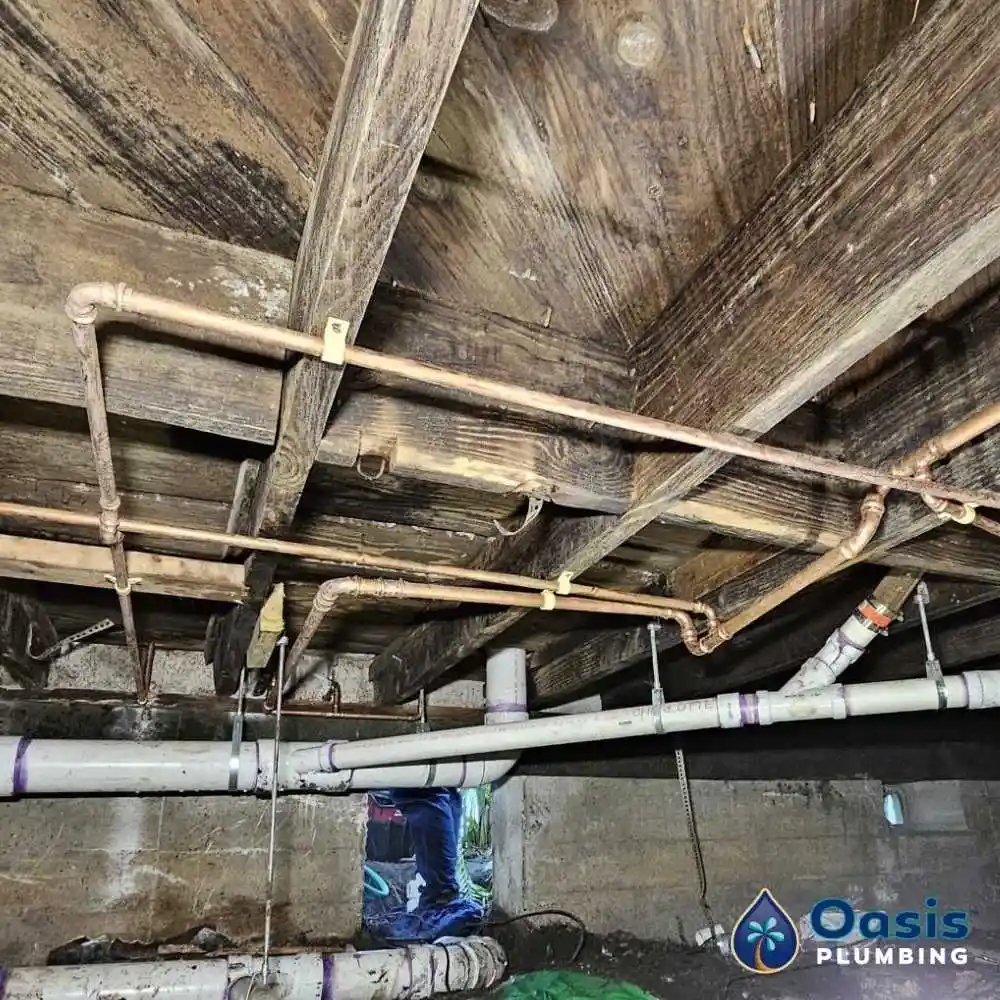
These observations help establish the extent of what can be confirmed and where additional evaluation may be appropriate.
However, not every pipe is accessible, and a visual inspection alone cannot establish the internal condition of every concealed water line.
Concerned About Older Pipes in Your Shorecrest Home?
Call Oasis Plumbing at (305) 703-8220 to discuss an evaluation of your water-supply piping before assuming the entire home needs repiping.
How Does a Plumber Evaluate Exposed Galvanized Pipes?
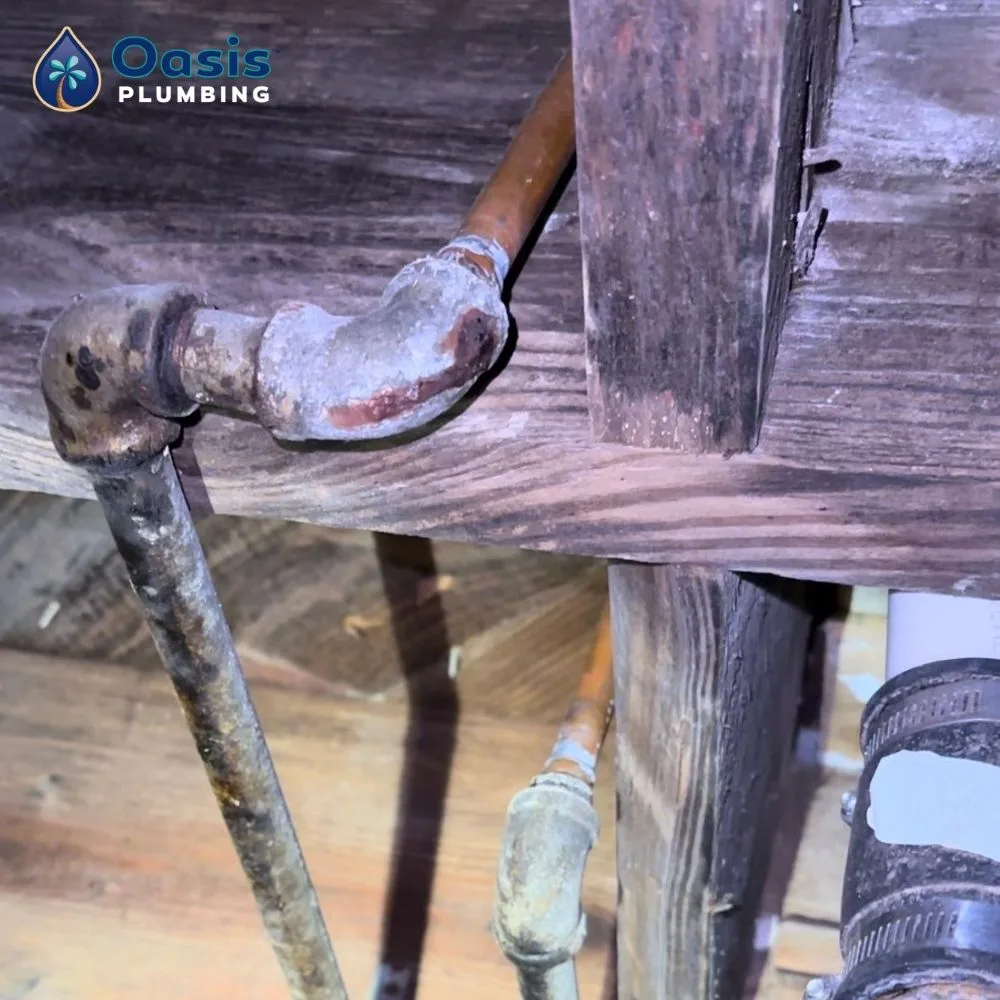
Exposed piping provides an opportunity to examine visible conditions without making assumptions about concealed sections.
Where pipes are accessible, a plumber may look for deterioration along the exterior surface, particularly around connections, fittings, and other areas where the pipe’s condition can be observed.
Visible findings might include corrosion, signs of leakage, or damage affecting a particular section.
The location and extent of those findings matter.
For example, visible deterioration concentrated around one connection provides different information from deterioration observed along several accessible sections.
Neither observation, by itself, confirms the condition of piping hidden inside walls or beneath other finished surfaces.
A pipe may appear relatively sound externally while still having internal restrictions. Conversely, an isolated exterior concern does not necessarily mean every connected pipe has the same problem.
This is why exposed pipe condition is useful evidence, but not the entire evaluation.
Why Are Connections and Fittings Important?
Pipe connections are important because they show how different sections of the water-supply system come together.
A plumber may examine accessible joints, fittings, and transitions for visible deterioration or signs of leakage.
Connections can also reveal where previous plumbing work altered the original arrangement.
For example, a newer section may connect to an older galvanized line through an existing fitting or transition.
Understanding these connections helps establish which portions of the system are related and whether a concern appears concentrated at one location.
Why Does a Plumber Look for Different Pipe Materials?
Different pipe materials can indicate that portions of the water-supply system were updated during previous repairs or renovations.
A home does not always receive a complete plumbing replacement during one project.
A bathroom renovation may involve new supply lines in that area, while older piping remains elsewhere. A previous repair may replace one damaged section without changing other branches.
As a result, a plumber may encounter a combination of galvanized piping and newer water lines.
During an inspection, the important question is not simply why different materials are present.
It is where each section begins, where it ends, and how it connects to the rest of the system.
This information helps establish which sections have already been updated and which older sections still require evaluation.
If your home contains a combination of older and newer water lines, our article on mixed plumbing pipes explains why that arrangement alone does not mean the entire house needs repiping.
How Does a Plumber Trace the Existing Plumbing Layout?
Tracing the plumbing layout helps identify which pipes supply different parts of the home and how individual branches connect to the broader water-supply system.
This is particularly important when some water lines have already been replaced or when accessible pipes do not clearly reveal the full arrangement.
A plumber may evaluate how the incoming supply connects to visible distribution lines and where accessible branches continue toward different fixtures or areas.
For example, one branch may supply a bathroom while another serves kitchen plumbing or additional fixtures.
Understanding those relationships helps establish whether a concerning pipe section is part of a localized branch or a broader shared supply path.
The evaluation may also consider:
Where accessible piping enters or leaves a particular area.
Which sections connect to common supply branches.
Whether newer lines connect back into older piping.
Where existing walls, floors, or other structures limit visibility.
Which portions of the layout remain uncertain without additional access.
The goal is to develop an accurate understanding of the system rather than assuming every visible section represents the plumbing throughout the home.
Why Do Access Conditions Matter?
Not every water line can be inspected in the same way.
Some piping may be visible beneath sinks, inside accessible utility areas, or along exposed portions of a structure. Other sections may be concealed behind finished surfaces.
These differences affect what a plumber can directly observe.
A visible section may provide useful evidence about its own condition, but it cannot automatically establish the condition of a concealed branch elsewhere.
Where access is limited, the plumber may need to explain which findings are confirmed and which areas remain unverified.
That distinction is important when determining how much of the plumbing system has actually been evaluated.
How Does a Plumber Determine Whether Deterioration Is Localized or More Widespread?
A plumber considers where deterioration has been observed, how the affected sections connect, and whether similar conditions are present elsewhere in the accessible plumbing system.
One damaged connection may indicate a localized problem.
Deterioration observed across several accessible sections may raise broader questions about the remaining piping.
However, neither finding should be treated as proof of the condition of every water line.
The evaluation may distinguish between:
| Inspection finding | What it may indicate |
|---|---|
| Deterioration concentrated at one accessible connection | A potentially localized concern |
| Damage along one exposed pipe section | A concern involving that particular section |
| Similar deterioration at several accessible locations | A reason to evaluate whether the concern is more extensive |
| Newer piping connected to older galvanized sections | Previous partial updates that need to be accounted for |
| Concealed piping that cannot be directly observed | An area where the condition remains unconfirmed |
The purpose is to separate what has actually been observed from what may still need investigation.
A professional evaluation should not assume that every concealed pipe is deteriorated simply because one exposed section shows damage.
Likewise, a single accessible section in good condition does not establish that the entire system is free from deterioration.
Does One Deteriorated Galvanized Pipe Mean the Others Are Also Damaged?
No. Finding deterioration in one galvanized pipe does not automatically establish the condition of every other water line in the home.
Different sections may have different exposure conditions, connection arrangements, repair histories, and levels of accessibility.
Some may have been replaced during previous plumbing work, while others remain original.
Even among older sections, visible deterioration may not be distributed uniformly.
This is why a galvanized pipe inspection should consider the broader plumbing arrangement rather than treating one finding as representative of the entire system.
For example, discovering deterioration around an exposed connection does not prove that every concealed branch has the same condition.
It may justify evaluating related sections, but the scope of concern still needs to be supported by the findings.
For homeowners in Shorecrest, this distinction helps prevent a localized problem from being automatically interpreted as a whole-home piping issue.
What Happens When Some Pipes Cannot Be Inspected Directly?
When piping is concealed or inaccessible, a plumber may not be able to confirm its condition through visual inspection alone.
This limitation matters because many residential water-supply systems include pipes behind walls, beneath floors, or within other finished areas.
An evaluation may establish the condition of accessible sections while leaving uncertainty about concealed portions.
The plumber can then consider the available evidence, the plumbing layout, and whether additional investigation is appropriate.
For example, visible connections may help establish where a concealed branch begins, but they may not reveal the condition of every section along that route.
Similarly, finding deterioration in one accessible area may raise questions about connected piping without proving that the concealed sections are affected.
The important distinction is between:
Confirmed findings
Conditions directly observed or otherwise established during the evaluation.
Unconfirmed areas
Sections whose condition cannot yet be determined from the available evidence.
Understanding that difference helps homeowners interpret inspection findings without assuming more than the evaluation actually establishes.
How Does Inspection Help Establish the Appropriate Plumbing Scope?
A galvanized pipe inspection helps determine whether the available findings point toward an isolated pipe problem or conditions that warrant discussing a broader repiping scope.
That does not mean the inspection automatically results in a recommendation to replace piping.
Instead, the findings can help answer questions such as:
Is the visible deterioration limited to one section?
Are several accessible areas affected?
Which older galvanized sections remain?
Have some branches already been updated?
How are the affected sections connected?
Are important portions of the system still concealed or unverified?
These questions help establish the extent of the known concern.
If the findings suggest a localized issue, the discussion may focus on that particular section.
If deterioration is observed across multiple related sections, a broader evaluation or repiping discussion may be appropriate.
For homeowners considering lead repiping and replacement in Shorecrest, understanding the distribution of deterioration is an important part of determining what scope should be discussed.
Where the concern involves a particular damaged water line, Oasis Plumbing’s water line repair and replacement service may also be relevant.
The purpose of inspection is to establish the condition and extent of the concern before deciding what plumbing work is appropriate.
Understand the Condition Before Deciding the Scope
If you’re concerned about deteriorating galvanized pipes in your Shorecrest home, call Oasis Plumbing at (305) 703-8220 to discuss an evaluation of the existing water-supply system.
Key Takeaways
A galvanized pipe inspection evaluates accessible piping, connections, previous replacements, branches, and the existing plumbing layout.
Visible deterioration provides information about the affected section but does not automatically establish the condition of concealed piping.
Different pipe materials may indicate previous partial plumbing updates.
Tracing pipe routes helps determine how older and newer sections connect and which areas they supply.
Access limitations can affect how much of the system can be directly evaluated.
Finding one deteriorated section does not mean every water line has the same condition.
Inspection findings help distinguish localized concerns from conditions that may warrant discussing a broader repiping scope.
Finding deterioration in an older galvanized pipe can raise understandable concerns about the rest of the plumbing system.
But one deteriorated section does not automatically mean every water line in the home has the same condition.
A professional galvanized pipe inspection considers the accessible piping, connections, previous replacements, branch lines, and existing plumbing layout to better understand where deterioration may be present.
For homeowners in Shorecrest, Miami, FL, that information helps establish whether the concern appears limited to a particular section or whether additional areas deserve evaluation.
The goal is to understand what has been confirmed, what remains uncertain, and how extensively the plumbing system may be affected before determining the appropriate scope of work.
If you’ve noticed deterioration in an exposed water line or have questions about the condition of older piping, our plumbers in Miami Shores at Oasis Plumbing can help you discuss the next steps for evaluating your plumbing system.
Call Oasis Plumbing at (305) 703-8220 to discuss galvanized water-supply piping concerns in Shorecrest, Miami, FL.
