

Finding mixed plumbing pipes in your home can raise an immediate question: if some water lines are newer but older piping remains elsewhere, does the entire house need to be repiped?
Not necessarily. Having a mixture of old and newer water pipes does not, by itself, mean the whole home needs repiping. A plumbing evaluation needs to determine which sections have already been updated, where older sections remain, and whether those remaining sections are actually contributing to a plumbing problem.
Homes can end up with mixed piping after previous repairs, renovations, fixture upgrades, or partial plumbing work. Instead of assuming everything needs replacement, the useful starting point is to understand the existing system.
For homeowners in Miami Shores Village, Shorecrest, and Belle Meade, that means looking beyond the simple fact that different pipe materials are present and determining how the remaining sections fit into the home’s water-supply system.
Table of Contents
Why Would a Home Have Both Old and New Plumbing Pipes?
A home can have mixed plumbing pipes when previous work updated only part of the water-supply system.
Plumbing does not always get replaced all at once.
A previous renovation may have involved one bathroom or kitchen. A past plumbing problem may have required work on a particular line. Another project may have updated piping only in an accessible portion of the home.
Over time, those separate projects can leave a water-supply system made up of sections installed at different times.
For example, a home could have newer piping serving a remodeled area while older galvanized piping remains along another route or branch.
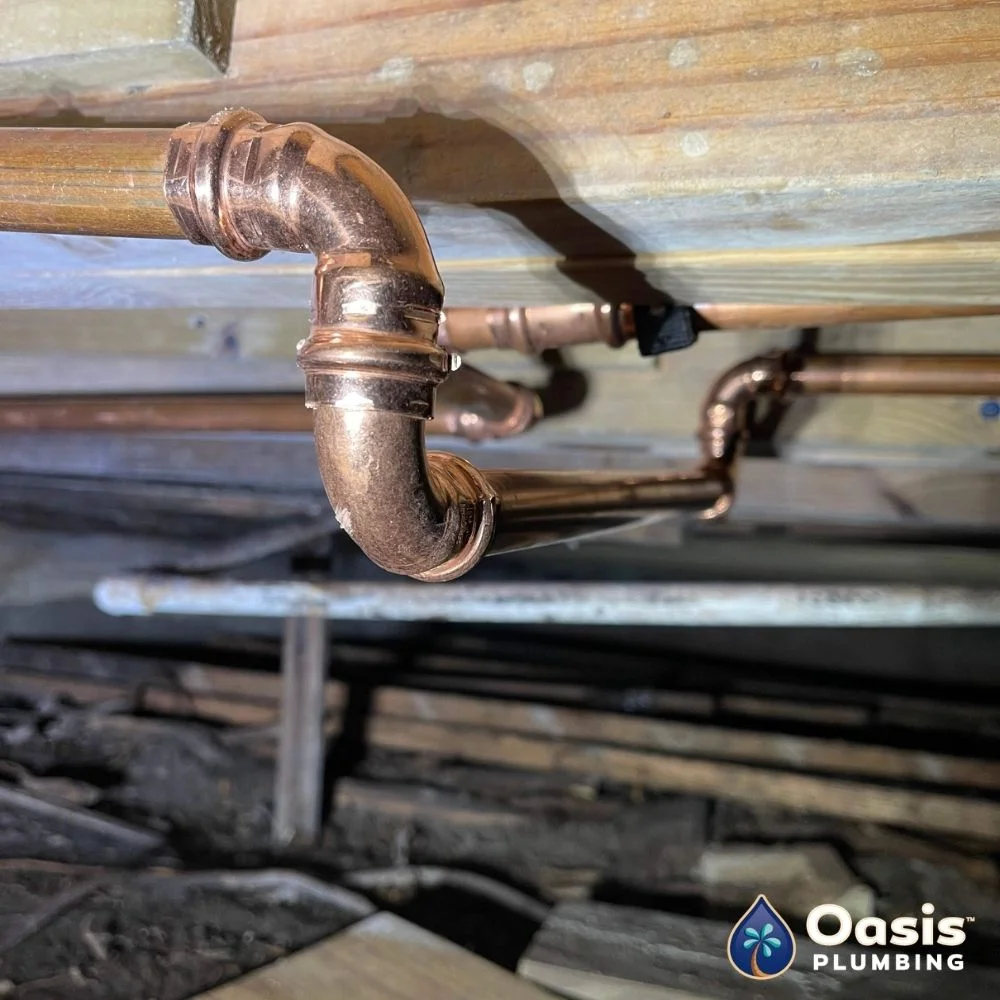
That situation does not automatically tell you whether the older section is still functioning adequately or whether additional work is needed.
It simply tells you that the home’s plumbing history is not uniform.
Not Every Pipe May Need the Same Solution
If your home has a combination of older and newer water lines, call Oasis Plumbing at (305) 703-8220 to discuss an evaluation of the existing water-supply piping before assuming the entire system needs replacement.
How Does a Plumber Evaluate a Home With Mixed Plumbing Pipes?
When a home contains old and newer piping, the goal is to understand what has already been updated and what remains.
That may involve evaluating:
where newer piping is present;
where older sections remain;
how different sections connect;
which areas or fixtures those sections supply;
whether an older section is associated with an existing plumbing concern; and
how the different sections fit into the broader water-supply system.
This matters because seeing newer pipe in one accessible location does not necessarily mean the plumbing has been updated everywhere.
Likewise, finding an older section does not automatically mean every remaining older line requires replacement.
The evaluation is about establishing the actual scope before deciding what work makes sense.
Why Does It Matter Where the Newer Piping Begins and Ends?
Tracing the transition between newer and older piping helps establish how much of the water-supply system has actually been updated.
Suppose newer piping is visible near a remodeled bathroom. That tells you something about that area, but it may not tell you what exists farther upstream or along another branch.
The newer section could connect back into older piping elsewhere.
Another branch could follow a completely different route.
This is why a mixed system cannot be evaluated accurately based on one visible pipe or one renovated room.
Plumbers may encounter multiple connections, routes, and existing conditions while assessing a home’s piping. Understanding those transitions helps build a clearer picture of which sections belong to previous updates and which portions of the older system remain.
That information becomes important when planning the scope of any future water line repair and replacement.
Do Remaining Galvanized Sections Need to Be Evaluated Separately?
Yes. Remaining galvanized sections should be considered based on their own condition, location, and relationship to the plumbing concern being investigated.
The presence of newer piping elsewhere does not tell you whether a particular older section is restricted or deteriorated.
At the same time, the presence of galvanized piping does not automatically prove that it is causing a current problem.
Consider a home where one section has already been updated while galvanized piping remains along another branch. If the homeowner is experiencing a problem in the area served by the older section, that section may deserve closer attention.
But the reasoning should still be: What section is involved? → What condition exists there? → What scope is appropriate?
Rather than: There is galvanized pipe → The entire house needs repiping.
That distinction helps keep the recommended work tied to what is actually found in the plumbing system.
For homeowners with remaining older water lines, lead repiping and replacement in Miami Shores Village may become relevant when an evaluation finds that those sections are contributing to the plumbing problem.
Does Mixed Plumbing Mean the Whole Home Needs Repiping?
No. Mixed plumbing materials alone do not establish that whole-home repiping is necessary.
A partially updated system may contain older sections that require attention, older sections that are not responsible for the current concern, or a combination of conditions that need to be evaluated individually.
The appropriate scope depends on what remains and what is happening within those remaining sections.
For example, an evaluation might find that a plumbing concern is limited to a particular older route or branch. In another home, the remaining older piping may be more extensive.
Those are different situations and should not automatically lead to the same recommendation.
The fact that a home has both old and new pipes is therefore a starting point for evaluation—not a diagnosis and not a repiping decision by itself.
How Can Mixed Piping Affect the Scope of Plumbing Work?
Mixed piping can make scope planning more specific because the plumber first needs to distinguish completed updates from remaining older sections.
Instead of treating the plumbing system as though nothing has ever been replaced, the evaluation can consider what work has already been done.
That can help answer practical questions such as:
Which sections are already newer?
Which older sections remain?
Where do the old and new sections connect?
Which part of the system serves the area experiencing a problem?
Is the concern isolated or does it involve a broader portion of the remaining piping?
These questions help define the scope around the home’s actual plumbing configuration.
They also help avoid making assumptions based solely on the age or material of one visible section.
For homeowners in Miami Shores Village, Shorecrest, or Belle Meade, this can be especially useful when previous owners or renovations have left behind a plumbing system that has been updated in stages rather than through one complete project.
What If Only Certain Fixtures Have a Problem?
When plumbing problems affect certain fixtures or areas but not others, the pattern can provide useful context about which part of the water-supply system deserves attention.
For example, one area may be supplied through a different branch than another. If an older section remains along that route, the relationship between the affected fixtures and the remaining piping can be evaluated.
However, a problem at one fixture does not automatically prove that an older pipe is responsible. Fixture-level issues and individual supply connections can produce localized symptoms too.
This is why the plumbing layout and the symptom pattern need to be considered together.
If the concern is specifically that some fixtures have stronger flow than others, “Uneven Water Flow in Your Miami Shores Village Home“ explains why a restriction in one section of older piping can affect fixtures differently without necessarily affecting the entire house.
Why Is Mapping the Existing Plumbing Important Before Deciding the Scope?
Understanding what has already been updated can prevent the scope from being based on assumptions about the entire home.
Without that context, seeing an older section might lead someone to assume that all of the plumbing is original. Seeing a newer section could create the opposite assumption—that most of the system has already been replaced.
Either assumption can be wrong.
A more useful evaluation establishes: what is newer → what remains older → how those sections connect → which sections are relevant to the current concern
From there, the appropriate scope can be considered based on the actual plumbing system rather than simply the presence of mixed materials.
That does not guarantee that only a small section will need attention. It also does not mean a broader project will always be necessary.
It means the scope should follow the findings.
Know What Has Already Been Updated
If you’re unsure how much of your home’s plumbing was replaced during previous renovations or repairs, call Oasis Plumbing at (305) 703-8220 to discuss an evaluation of the existing water-supply lines.
What Should Homeowners Know Before a Plumbing Evaluation?
If you know that plumbing work has been completed previously, any information you have about those projects may provide useful context.
That could include knowing:
which room or area was renovated;
whether a previous repair involved a particular water line;
where newer piping has been observed; or
whether the current plumbing concern is concentrated in a specific part of the home.
You do not need to determine the entire pipe layout yourself.
The purpose of the evaluation is to establish which portions have already been updated and which older sections remain before determining an appropriate scope.
This is particularly important with mixed plumbing pipes, because the system may reflect several different projects completed at different times.
Key Takeaways
Mixed plumbing pipes do not automatically mean the entire home needs repiping.
Homes can end up with old and newer piping after partial repairs, renovations, or previous plumbing updates.
Seeing newer piping in one location does not prove that the entire water-supply system has been updated.
Remaining galvanized sections should be evaluated based on their own condition and relationship to the plumbing concern.
Tracing where newer piping begins, where older piping remains, and how those sections connect can help establish the actual scope.
Problems affecting certain fixtures or areas may provide useful clues about which plumbing route deserves closer evaluation.
A plumbing evaluation can map the existing system before determining whether the appropriate scope is localized or more extensive.
Finding both older and newer pipes in a home can make the plumbing system look complicated, but the mixture itself does not determine what needs to be replaced.
Previous renovations and repairs may have updated certain sections while leaving other water lines in place. The important step is understanding where those updates stop, where older piping remains, and whether the remaining sections are connected to the problem being investigated.
For homes in Miami Shores Village, Shorecrest, and Belle Meade, evaluating the system this way helps keep the scope tied to the plumbing that is actually present.
Sometimes the relevant area may be limited. In other situations, the remaining older piping may be more extensive. The decision should follow the evaluation rather than the simple fact that old and new pipes exist in the same home.
If previous renovations or plumbing work have left your home with a mixture of older and newer water lines, Our plumbers in Miami Shores at Oasis Plumbing can help evaluate what has already been updated and what sections remain.
Call Oasis Plumbing at (305) 703-8220 to discuss your water-supply piping in Miami Shores Village, Shorecrest, Belle Meade, or elsewhere in Miami-Dade.
