

You turn on one faucet and the water flows normally. In another bathroom, the sink barely seems to keep up. Maybe the shower is fine while a nearby faucet is noticeably weaker.
When you have uneven water flow in house plumbing, the difference between fixtures can sometimes provide an important clue about where the problem is occurring.
Older galvanized piping is one possible explanation. Deterioration or restriction inside certain sections of pipe can reduce the amount of water reaching some fixtures without affecting every fixture equally. But uneven flow alone does not prove that galvanized pipes are responsible—or that repiping is automatically necessary.
For homeowners in Miami Shores Village, the useful question is not simply, “Are my pipes old?” It is: Where is the restriction occurring, and what part of the plumbing is actually affected?
Table of Contents
Can Galvanized Pipes Cause Different Water Flow at Different Fixtures?
Yes. Internal restriction within sections of galvanized piping can potentially affect water flow differently from one fixture to another.
Water does not necessarily travel through one identical pipe all the way to every faucet, shower, and toilet. A home’s water-supply system branches as it distributes water to different areas and fixtures.
If a restriction develops within one portion of that system, fixtures supplied through that section may experience reduced flow while fixtures served by a different path continue to perform normally.
That means you could potentially have:
strong flow at one faucet;
noticeably weaker flow at another;
normal water delivery in one bathroom;
reduced flow in another area; or
repeated flow differences among fixtures supplied by the same part of the plumbing.
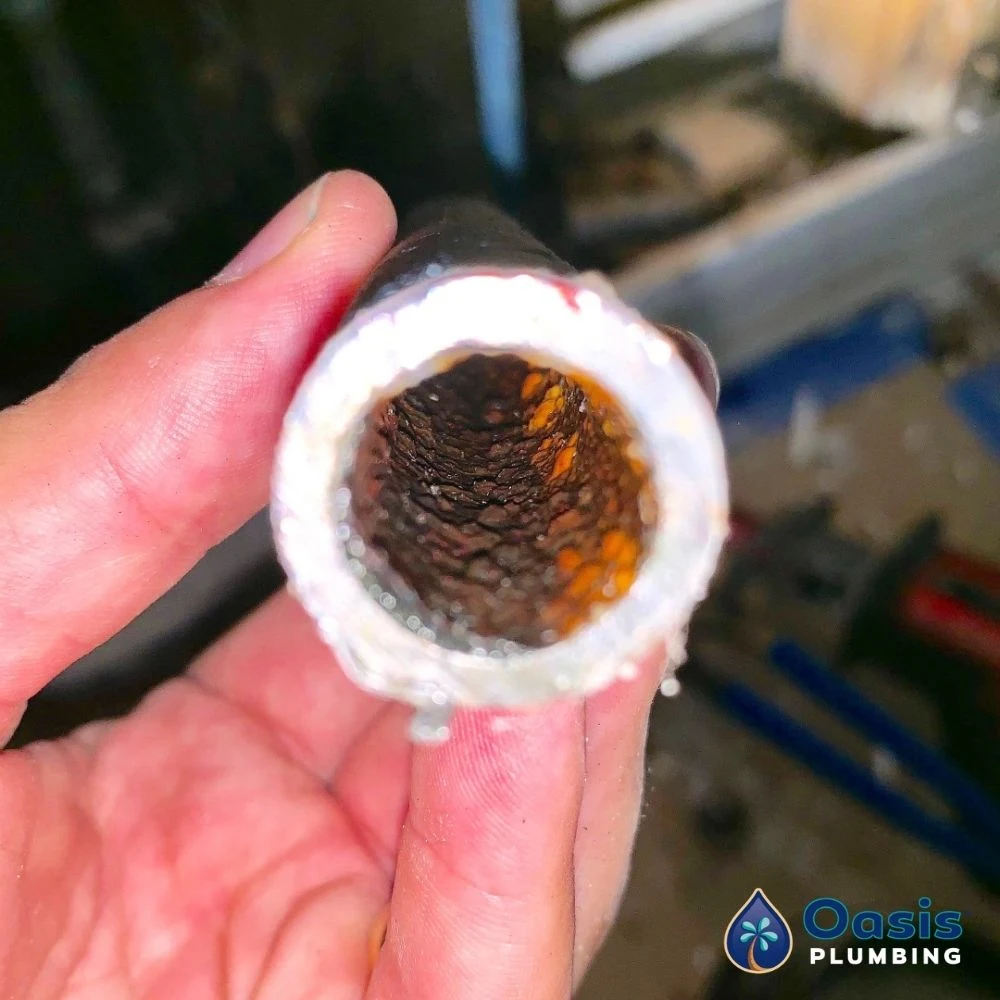
The pattern matters because it can help narrow down whether the issue is close to an individual fixture or located deeper within the water-supply piping.
If the shower is downstream of the filtration equipment and supplied by the treated water path, its water can pass through the whole-house filter before reaching the fixture.
One Strong Faucet Doesn't Tell the Whole Story
If certain fixtures in your Miami Shores Village home repeatedly have weaker flow than others, call Oasis Plumbing at (305) 703-8220 to have the affected plumbing evaluated.
Why Can Older Galvanized Pipes Affect Fixtures Differently?
Galvanized piping can develop internal deterioration and restriction over time. If that restriction reduces the usable opening inside a particular section of pipe, less water may be able to move through that section.
The important point for this article is that the restriction does not necessarily have to affect the entire plumbing system equally.
Imagine that a supply line eventually divides into separate branches. One branch supplies part of the home, while another continues toward a different area.
If the restriction is primarily within one branch, the fixtures connected to that branch may experience reduced flow while fixtures connected elsewhere continue receiving stronger flow.
That is one reason uneven water delivery can be more complicated than simply deciding whether the home’s overall water pressure is “good” or “bad”.
The location of the restriction matters.
If One Faucet Has Strong Flow, Can the Pipes Still Be Restricted Elsewhere?
Yes. One faucet with strong water flow does not automatically rule out a restriction somewhere else in the plumbing.
A strong fixture tells you that water is reaching that particular fixture reasonably well. It does not prove that every branch and individual supply line in the home has the same internal condition.
For example, suppose a kitchen faucet has strong flow but a bathroom sink on another part of the plumbing has consistently weaker flow. If those fixtures are supplied through different branches, a restriction affecting the bathroom’s water path may not significantly affect the kitchen faucet.
The same principle can work in reverse. Several fixtures in one part of the house might perform normally while another group repeatedly experiences weaker water delivery.
That is why comparing fixtures can provide useful information, but it cannot identify the cause by itself.
Is the Problem at One Fixture or Along a Plumbing Branch?
The number and location of affected fixtures can help plumbers in Miami Shores determine where to investigate.
If only one fixture has weak flow, the cause may be relatively close to that fixture. An aerator, fixture valve, or individual supply connection could be involved.
If multiple fixtures supplied through a related area have similar problems, the possibility of a restriction farther back in the branch becomes more relevant.
If the problem appears much more broadly throughout the home, the investigation may need to move farther upstream.
This doesn’t mean homeowners need to map their own plumbing system or diagnose which pipe is restricted. Instead, the pattern of affected fixtures gives a plumber information that can help narrow the search.
A useful description might be: “The upstairs bathroom sink has weak flow, but the shower is normal, and the downstairs fixtures seem fine.”
That is more informative than simply saying, “My water pressure is low”.
The goal is to determine where normal water delivery changes within the plumbing system.
Could the Problem Be Something Simpler Than the Pipes?
Absolutely. Uneven flow does not automatically mean the home’s galvanized piping is restricted or needs replacement.
Several more localized issues can create similar symptoms, including:
debris or buildup at a faucet aerator;
a partially restricted fixture valve;
an issue with an individual fixture;
a restriction in a fixture's supply connection; or
another localized plumbing condition.
This distinction is particularly important when only one fixture is affected.
For example, if a faucet has weak flow because its aerator is obstructed, replacing piping elsewhere in the house would not address the actual cause.
That is why the simpler fixture-related possibilities should not be skipped just because older piping is present.
Likewise, finding an issue at one fixture does not automatically explain recurring problems at several other fixtures. Each pattern needs to be considered in context.
Why Does the Location of the Restriction Matter?
Finding where the restriction occurs helps determine what plumbing work, if any, is actually appropriate.
A restriction at an individual fixture is very different from a problem within a branch line. A branch-line restriction is different from a broader problem affecting the water-supply piping.
Without locating the likely problem area, it is easy to jump from a symptom—weak water flow—to a much larger conclusion such as “the house needs repiping”.
That conclusion may not be justified.
For Miami Shores Village homeowners, professional evaluation becomes more useful when the same flow problems continue after straightforward fixture-related causes have been considered.
At that point, evaluating the water-supply piping can help determine whether a deeper restriction or deterioration is contributing to the uneven flow.
Homeowners dealing with concerns involving older supply piping can learn more about lead repiping and replacement in Miami Shores Village and how Oasis Plumbing approaches water-line concerns in the area.
The goal is to determine where normal water delivery changes within the plumbing system.
Does Uneven Water Flow Mean Galvanized Pipes Need to Be Replaced?
No. Uneven water flow by itself is not enough to conclude that galvanized piping needs replacement.
The symptom tells you that water delivery is not consistent. It does not tell you why.
If the cause is an aerator, valve, individual supply connection, or another localized issue, the solution may have nothing to do with replacing broader sections of piping.
If an evaluation instead finds meaningful deterioration or restriction within the water-supply piping, then the conversation can shift toward what part of the system is affected and what options are appropriate.
This is why diagnosis should come before assumptions about repiping. When the issue is traced to the home’s water-supply piping, water line repair and replacement may be considered based on the location and extent of the problem.
When Should the Water-Supply Piping Be Evaluated?
A closer evaluation of the water-supply piping may make sense when flow problems repeatedly affect particular fixtures or areas and straightforward fixture-related explanations have already been ruled out.
Patterns worth describing to the plumber include:
which fixtures have weaker flow;
which fixtures remain strong;
whether affected fixtures are concentrated in one area;
whether both nearby fixtures behave differently; and
whether the problem continues after obvious fixture-level restrictions have been addressed.
These observations do not diagnose the problem, but they can help establish the pattern.
From there, the goal is to determine whether the restriction is at the fixture, within an individual connection, along a branch, or deeper within the water-supply system.
When the concern involves a specific damaged or restricted section rather than a broader piping issue, water line repair and replacement may also be relevant to the evaluation.
Repeated Flow Differences Deserve a Closer Look
If simple fixture-related causes have been ruled out but certain areas still have weaker water flow, call Oasis Plumbing at (305) 703-8220 to discuss an evaluation of your water-supply piping.
Key Takeaways
Older galvanized piping can develop internal restrictions that affect water flow.
A restriction in one section or branch may affect some fixtures more than others.
One faucet with strong flow does not prove that every part of the home's water-supply piping is unrestricted.
The pattern of affected fixtures can help distinguish a localized issue from a problem farther back in the plumbing.
Aerators, valves, individual supply connections, and other fixture-level issues can also cause uneven flow.
Uneven water flow in house plumbing does not automatically mean galvanized pipes need replacement.
When recurring flow differences remain after simpler causes have been ruled out, evaluating the water-supply piping can help determine whether a deeper restriction exists.
If one fixture in your Miami Shores Village home has strong flow while another is noticeably weaker, it can be tempting to assume the problem either must—or cannot—be the pipes.
Neither conclusion is reliable on its own.
Because household water-supply piping branches toward different fixtures, a restriction within one section can potentially affect certain areas without producing the same symptom everywhere. At the same time, fixture aerators, valves, individual supply connections, and other localized issues can create very similar symptoms.
The important question is where the water flow begins to become restricted.
When the problem repeatedly affects particular areas and simpler fixture-related causes have been ruled out, evaluating the water-supply piping can determine whether deterioration or restriction deeper in the system may be contributing to the uneven flow.
If some fixtures in your home repeatedly have weaker water flow while others remain strong, Oasis Plumbing can help determine whether the issue is localized to a fixture or may involve the water-supply piping.
Call Oasis Plumbing today at (305) 703-8220 to discuss your plumbing concerns in Miami Shores Village.
