

When bottled water becomes your household’s everyday drinking-water source, it also becomes something you have to keep buying, carrying, storing, and replacing. That practical routine is one of the biggest differences in the reverse osmosis vs bottled water comparison.
An at-home reverse osmosis system changes how filtered drinking water reaches your household. Instead of bringing your drinking water home in bottles, the system provides filtered water at a designated faucet whenever you need it during normal operation.
That doesn’t make reverse osmosis universally better, safer, or healthier than bottled water. Bottled water still offers portability and may be perfectly practical for households that use it occasionally.
The real comparison is about how you want everyday drinking water to fit into your home. If bottled water has become a constant item on your shopping list, takes up valuable storage, or regularly runs out, having filtered water available at the sink can offer a very different experience.
Table of Contents
Reverse Osmosis vs Bottled Water: The Biggest Difference Is How You Get Your Water
For everyday household use, reverse osmosis and bottled water represent two different delivery methods.
With bottled water, your household relies on a supply that has already been packaged. You purchase it, bring it into the home, store it, and use it until it’s gone.
With reverse osmosis, filtered drinking water is produced by equipment installed at a designated point of use. Rather than replenishing cases or individual bottles, you access filtered water from the system.
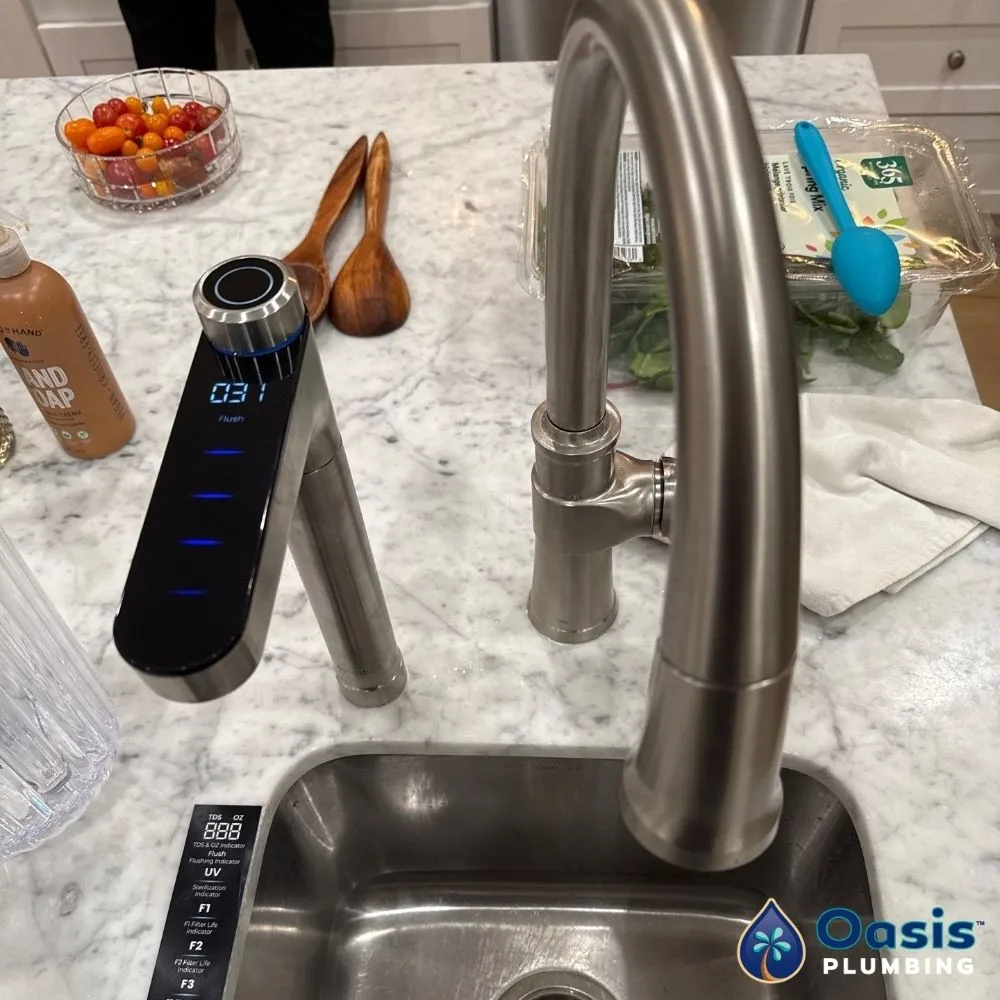
Here’s how that difference can affect daily life:
| Everyday Consideration | At-Home Reverse Osmosis | Bottled Water |
|---|---|---|
| Availability at home | Filtered water available at the designated faucet during normal operation | Limited to the bottles you currently have |
| Purchasing routine | No repeated bottled-water purchases for routine home use | Supply must be replenished |
| Carrying | No cases to carry home for everyday use | Bottles or cases must be transported |
| Storage | Requires appropriate system space | Requires space for bottles or cases |
| Running out | Not dependent on the number of bottles stored | Supply ends when the bottles are gone |
| Portability | Fill a reusable container to take water with you | Bottles are already portable |
Neither column automatically wins.
The better fit depends on which routine works better for your household.
Put Filtered Water Where You Use It
Replace the bottled-water routine with professionally installed drinking water filtration—call Oasis Plumbing at (305) 703-8220.
Bottled Water Is More Than a Purchase—It's an Ongoing Household Task
One case of bottled water may not seem like much work.
The difference becomes more noticeable when bottled water is the household’s primary drinking-water source and the same routine repeats week after week.
Someone has to:
Notice when the supply is getting low.
Add more water to the shopping list or place an order.
Purchase or receive the bottles.
Bring them into the home.
Find somewhere to store them.
Keep enough available for everyone who uses them.
Deal with the empty containers.
Start the process again.
For a person living alone who occasionally reaches for bottled water, that may be insignificant.
For a family that uses bottled water for glasses throughout the day, school or work bottles, beverages, and guests, it can become a regular household chore.
That’s why consumption habits matter when comparing reverse osmosis vs bottled water.
The more frequently your household uses bottled water, the more noticeable the purchasing and replenishment cycle becomes.
Reverse Osmosis Changes Drinking Water From Inventory to Access
An at-home reverse osmosis system changes the routine because your household no longer has to keep its primary drinking-water supply sitting in bottles.
Filtered water is instead available at the designated faucet during normal system operation.
Think about how that changes common situations.
You Want a Glass of Water
With bottled water, you take one from the supply. With reverse osmosis, you use the filtered-water faucet.
You're Filling Bottles Before Work or School
Instead of taking several disposable bottles from a case, you can fill reusable bottles from the reverse osmosis system.
You're Preparing a Drink
Filtered water can be drawn from the point of use instead of consuming another bottle from the household supply.
Guests Want Water
You don't have to think about whether enough bottles are left in the refrigerator or pantry for everyone.
None of these individual moments is dramatic.
That’s precisely the point.
The convenience of at-home reverse osmosis tends to show up through small, repeated moments rather than one major event. For households that consume a lot of drinking water at home, removing those little supply-management tasks can change the everyday experience considerably.
Storage Can Become a Bigger Issue Than Homeowners Expect
Bottled water has to live somewhere between the store and your glass.
For occasional use, a few bottles in the refrigerator or pantry may be easy to accommodate. Households buying water by the case may need considerably more space.
That can mean using:
pantry shelves;
kitchen storage;
refrigerator space;
a garage;
a utility area;
or available floor space.
This creates an important tradeoff.
Bottled water requires storage for the water itself. Reverse osmosis requires dedicated space for the filtration equipment.
Reverse osmosis doesn’t make space requirements disappear. It changes what you’re making room for.
Instead of repeatedly storing cases of consumable water, you accommodate equipment intended to provide filtered water at its point of use.
Which arrangement feels more practical depends on the home.
If you have plenty of storage and bottled water rarely gets in the way, this may not be a major consideration.
If cases are constantly being moved around, stacked wherever they’ll fit, or occupying storage you’d rather use for something else, the difference becomes much more relevant.
Stop Storing Your Everyday Water Supply
Move from cases of drinking water to filtered water at the sink—call Oasis Plumbing at (305) 703-8220.
Running Out Is Part of Relying on Bottled Water
If your household depends on bottled water, availability is directly tied to inventory.
When the last bottle is gone, so is that supply.
Usually this isn’t a serious problem. It is, however, another recurring inconvenience.
Someone has to keep track of how much remains. If the household uses water faster than expected, another purchase may be needed sooner than planned.
You might recognize the routine:
“Didn’t we just buy water?”
That’s a small but useful clue about how much bottled water your household actually goes through.
Reverse osmosis handles availability differently. During normal system operation, filtered water is produced through the installed system rather than being limited to a fixed number of bottles already in the house.
For some homeowners, not having to monitor drinking-water inventory is one of the strongest practical reasons to consider a permanent point-of-use system.
Your Household's Drinking Habits Change the Comparison
There is no universal threshold where bottled water suddenly becomes inconvenient.
A better approach is to look at your own routine.
Bottled Water May Still Feel Simple When
only one person regularly uses it;
your household drinks relatively little bottled water at home;
cases last a long time;
you have plenty of convenient storage;
purchasing it is already part of an easy routine;
or portability matters more than access from a dedicated faucet.
At-Home Reverse Osmosis May Become More Appealing When
several people rely on filtered drinking water;
bottled-water cases disappear quickly;
you frequently fill reusable bottles;
storage is becoming inconvenient;
someone regularly has to replenish the supply;
or you want filtered water readily available from one point of use.
This isn’t about proving that one household is making the “better” choice.
It’s about recognizing that usage determines how much the delivery method matters.
Someone who consumes four bottles a week experiences bottled water very differently from a household that goes through several cases.
Bottled Water Has One Clear Convenience Advantage: Portability
A fair reverse osmosis vs bottled water comparison should acknowledge where bottled water is genuinely convenient.
Packaged water travels easily.
You can put bottles in:
a lunch bag;
the car;
a cooler;
a gym bag;
or a backpack.
An installed reverse osmosis system obviously cannot travel with you.
But this doesn’t necessarily create an either-or decision.
A household using reverse osmosis at home can fill reusable bottles before leaving. Some homeowners may also choose to keep packaged water for travel, guests, outdoor activities, or other situations where it remains convenient.
The lifestyle decision therefore doesn’t have to be:
Reverse osmosis OR bottled water forever.
It can be:
What should provide most of our everyday drinking water at home?
That narrower question makes the comparison much more practical.
Convenience at the Sink Matters Most When That's Where You Already Use Water
The value of at-home reverse osmosis is closely connected to routine.
If you already go to the kitchen whenever you want a glass of water, fill a reusable bottle, or prepare a beverage, having filtered drinking water available there fits naturally into an existing habit.
You aren’t creating a new routine.
You’re changing what happens at a location you already use.
This is one reason homeowners tired of buying bottled water may begin considering professional drinking water filter installation instead.
The shift isn’t simply from “bottle” to “filter”.
It’s from stored supply to on-demand household access at the designated point of use.
For a household that primarily consumes its filtered water at home, that difference can be significant.
Reverse Osmosis Doesn't Have to Replace Every Bottle You Ever Buy
Installing reverse osmosis doesn’t mean bottled water must disappear completely from your life.
That expectation makes the decision unnecessarily rigid.
You might still prefer bottled water when:
traveling;
attending an event;
keeping water in a vehicle;
preparing for situations away from home;
or serving water where reusable bottles aren't practical.
The question is whether bottled water needs to remain your everyday household supply.
A family might substantially reduce its reliance on cases at home while occasionally buying packaged water for convenience elsewhere.
That can be a more realistic goal than trying to eliminate every bottle.
It also keeps this comparison focused on what the title promises: everyday drinking at home.
What About the Environmental Difference?
Packaging and discarded bottles are reasonable considerations when comparing these two approaches, but they should not take over the decision.
A household that uses less bottled water may naturally use fewer single-use containers. However, a complete environmental comparison would involve more than simply counting bottles. Manufacturing, transportation, filtration equipment, water use, and other factors could all become relevant.
That is a much larger topic than this article owns.
For the homeowner deciding how they want to receive drinking water every day, the simpler practical observation is enough:
Bottled water depends on a continuing supply of containers. An installed reverse osmosis system does not require individual bottles to provide routine drinking water at home.
From there, homeowners can decide how much that difference matters to them without turning a lifestyle comparison into a full environmental analysis.
Don't Turn This Into a Safety Contest
Another common mistake is trying to make reverse osmosis vs bottled water a universal argument about which is “safer” or “healthier”.
That’s not what this comparison can responsibly establish.
Water characteristics can depend on the source, filtration system, product, household conditions, and other factors. Broad claims that one delivery method is universally safer would oversimplify those differences.
The more useful comparison here is about homeowner experience:
How is drinking water obtained?
How often does it need to be replenished?
Where does it need to be stored?
How readily is it available at home?
How well does the routine fit the household?
Those are questions homeowners can answer based on their actual habits.
And they are often enough to reveal whether the current approach still makes sense.
The Real Question: Are You Tired of Managing Your Drinking-Water Supply?
Sometimes the strongest argument for changing a household routine isn’t a dramatic problem.
It’s repetition.
You buy water.
You carry it home.
You store it.
You notice you’re running low.
You buy it again.
If that routine doesn’t bother you, bottled water may continue to work perfectly well for your household.
If you’ve become tired of it, that frustration tells you something important: the way you’re getting drinking water may no longer fit the way your household uses it.
At that point, professional reverse osmosis installation becomes less about chasing a new product and more about changing the delivery method.
Instead of continually bringing filtered drinking water into the house, you’re considering whether it would be more practical to produce it at the point where you already use it.
Replace Replenishment With Everyday Access
Get filtered drinking water where your household uses it instead of continually replacing cases—call Oasis Plumbing at (305) 703-8220.
A Quick Household Test Before You Decide
Before deciding that you need to change anything, pay attention to your bottled-water routine for a week or two.
You don’t need a spreadsheet.
Simply notice:
How often do you buy it? Frequent replenishment makes the convenience difference more meaningful.
How much space does it occupy? Look at where unopened cases and cold bottles actually live.
How quickly does it disappear? High household use can make inventory management more noticeable.
Who is responsible for replacing it? Sometimes the inconvenience falls mostly on one household member.
Where do you drink most of it? If most bottled water is consumed in the kitchen or at home, an installed point-of-use system may fit naturally.
What frustrates you about the routine? Carrying, storage, running out, or repeated purchasing may matter differently to different homeowners.
If you barely notice the bottled-water routine, you may have little reason to replace it.
If you notice it constantly, that’s useful information too.
Not everyone relying on bottled water needs an installed reverse osmosis system.
The value depends on whether changing the routine would meaningfully improve everyday life in your home.
When the Question Changes From Bottled Water to Reverse Osmosis Installation
Once a homeowner decides that filtered water available at home sounds more practical than continually managing bottles, the decision naturally moves into a different stage.
Now the question becomes whether a professionally installed reverse osmosis system fits the household and the proposed setup.
For homeowners considering reverse osmosis installation in Miami Shores Village, that can be a logical point to have the installation conditions professionally evaluated.
Professional evaluation also doesn’t mean a homeowner has already committed to reverse osmosis.
It means the conversation has progressed from:
“Am I tired of relying on bottled water?”
to:
“Would an installed system make more sense for the way my household drinks water?”
That’s the natural conversion bridge for this topic.
Key Takeaways
Reverse osmosis and bottled water use different delivery methods: One provides filtered water through installed equipment; the other requires maintaining a packaged supply.
Bottled water creates recurring household tasks: Purchasing, carrying, storing, monitoring, and replenishing become more noticeable as consumption increases.
Reverse osmosis changes inventory into access: Filtered water can be available at the designated point of use during normal operation.
Both approaches require space: Bottled water needs recurring storage, while reverse osmosis requires appropriate space for installed equipment.
Bottled water remains useful for portability: At-home filtration doesn't mean you can never use packaged water again.
Household habits matter: The more bottled water your household consumes, the more meaningful the convenience difference may become.
This isn't a universal safety or health comparison: The better lifestyle fit depends on how your household wants to obtain and use drinking water.
Not everyone needs to switch: If buying and storing bottled water is easy for your household, there may be little reason to change solely for convenience.
In the reverse osmosis vs bottled water comparison, the better everyday option depends largely on which routine you prefer.
Bottled water offers simple portability and requires no installed filtration equipment. For occasional users, keeping a few bottles available may be entirely practical.
The experience changes when bottled water becomes the household’s primary drinking-water supply. Repeated purchases, carrying cases, finding storage, monitoring what’s left, and replenishing the supply all become part of the routine.
At-home reverse osmosis replaces much of that inventory management with filtered water available at a designated point of use.
That doesn’t make it universally better. It makes it different in a way that may matter greatly to households tired of managing bottles.
If the bottled-water routine rarely crosses your mind, you may be perfectly comfortable continuing it.
If you’re constantly buying another case, moving bottles around to make room, or realizing you’re nearly out again, the more useful question may no longer be whether bottled water works.
It may be whether you still want to manage drinking water that way.
If repeated bottled-water purchases and storage no longer fit your household, Oasis Plumbing can evaluate whether professionally installed reverse osmosis makes sense for your everyday drinking-water routine.
Call Oasis Plumbing at (305) 703-8220 today to get professional guidance on a point-of-use setup that fits your home rather than continuing to manage cases simply because that’s what you’ve always done.
