

First, a galvanized water pipe develops a leak beneath the house. You have that section repaired, and everything seems fine.
Months later, another leak appears. This time, it’s along a different water line.
After another repair, you begin wondering whether these are separate plumbing problems or signs of something happening throughout the older piping system.
If a galvanized pipe keeps leaking in different parts of your home, it may be time to evaluate more than the section that failed most recently.
Repeated leaks at different locations can indicate that deterioration is affecting multiple sections of an older water-supply system. However, even several repairs do not automatically mean the entire home needs repiping.
For homeowners in Belle Meade, Miami, FL, the important distinction is whether the failures are isolated incidents or part of a developing pattern involving the remaining galvanized piping.
Understanding that difference can help you determine when another localized repair may be reasonable and when a broader plumbing evaluation deserves consideration.
Table of Contents
When Do Repeated Galvanized Pipe Leaks Become a Bigger Concern?
Repeated galvanized pipe leaks become a reason for broader evaluation when failures begin occurring at different locations rather than remaining confined to one isolated section.
One leak may involve a particular damaged pipe or connection.
A second leak does not automatically establish a system-wide problem either.
However, when separate sections of older galvanized piping begin failing over time, the repair history becomes more important.
For example, consider a home where:
A leaking connection is repaired beneath one bathroom.
Another galvanized section develops a leak along a different branch.
A later failure occurs in another part of the water-supply system.
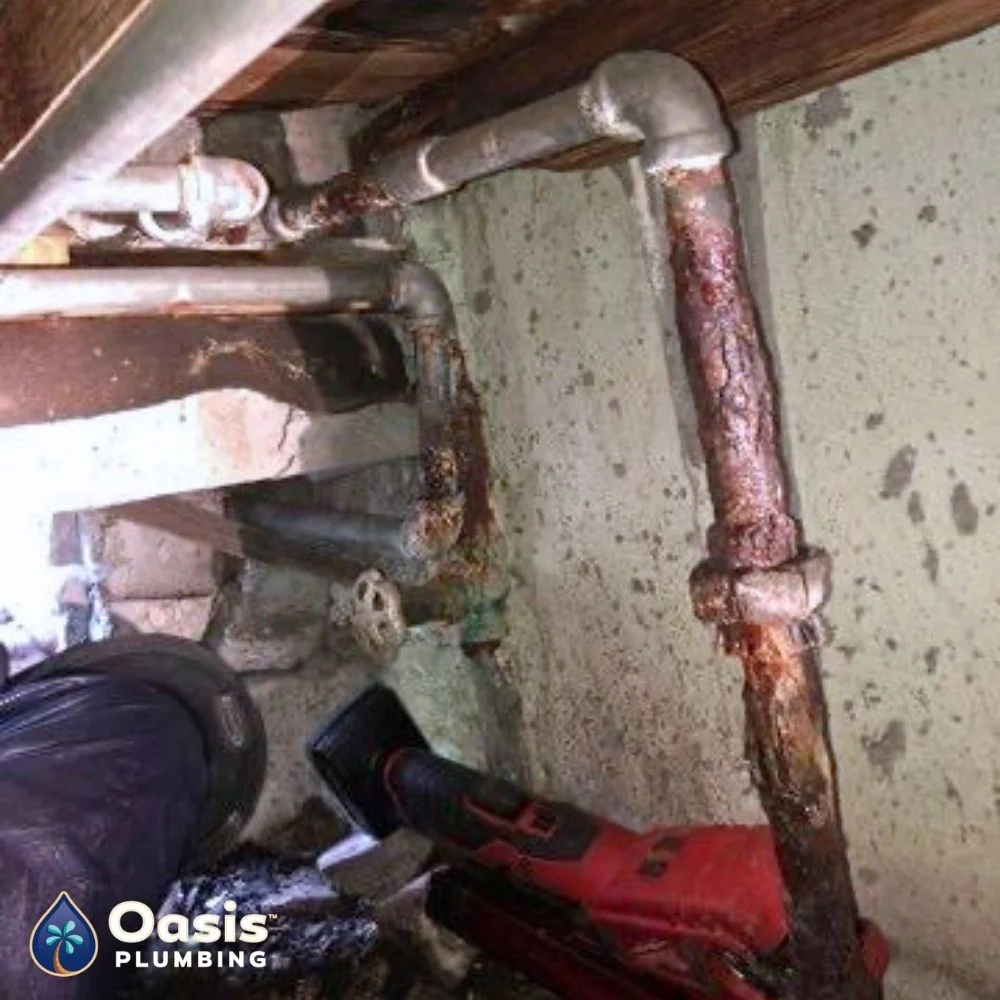
Each repair may address the immediate problem at its location.
But the pattern raises a different question: Are these unrelated failures, or is deterioration affecting multiple sections of the remaining piping? That question cannot be answered simply by counting repairs.
It requires evaluating where the failures occurred, which pipes were involved, and what condition remains elsewhere in the system.
Dealing With Repeated Water Line Repairs?
If galvanized pipes have developed leaks in different parts of your Belle Meade home, call Oasis Plumbing at (305) 703-8220 to discuss an evaluation of the remaining water-supply piping.
Why Doesn't Repairing One Leaking Section Fix the Other Galvanized Pipes?
Repairing one damaged section addresses the problem at that location. It does not restore the condition of other galvanized pipes that remain in the system.
A water-supply system consists of connected sections and branches serving different areas of the home.
When a plumber repairs or replaces one leaking section, the work focuses on that affected area. Other older pipes may remain unchanged. If those sections have their own deterioration, the previous repair does not correct it.
For example, suppose a leaking pipe beneath a bathroom is replaced. That work may resolve the leak in that particular section.
However, an older galvanized line serving another part of the home may still have its own condition issues. If that second line later develops a leak, it does not necessarily mean the first repair was unsuccessful.
It may mean that another section of the existing system has failed independently.
This is an important distinction for homeowners who feel as though their plumbing keeps developing the same problem.
The leak may be new even when the broader concern involves the same remaining older piping system.
What Is the Difference Between a Repeated Galvanized Pipe Leak and a New Leak Elsewhere?
A repeated leak at the same location and a new leak in a different section can point toward different plumbing concerns.
If water continues leaking from the same repaired area, the plumber may need to investigate that particular repair, connection, or adjoining piping.
But when a leak develops in a separate section, the question shifts toward the condition of that additional pipe.
Consider these two situations.
| What happens | What it may indicate |
|---|---|
| Water continues leaking at the same repaired connection | The original area may need further evaluation |
| A nearby section develops a leak | Deterioration may extend beyond the original repair |
| A different branch develops a separate leak | Another portion of the older system may be affected |
| Several unrelated locations fail over time | The distribution of failures may justify broader evaluation |
The distinction matters because repeated failures are not always repetitions of the same plumbing defect.
A homeowner may describe the situation as the same pipe problem happening again, even though each leak involves a different section.
Identifying the actual locations helps determine whether the concern remains localized or extends into other parts of the water-supply system.
Why Does the Location of Each Previous Galvanized Pipe Repair Matter?
The location of previous repairs helps a plumber understand whether failures are concentrated in one area or distributed across the existing piping system.
A home may have several galvanized water lines connected through different branches.
If multiple leaks have occurred along one short section, the concern may remain concentrated within that particular area. If failures have occurred along separate branches, the distribution may suggest that more of the remaining system deserves evaluation.
For example, a homeowner in Belle Meade may have had one section repaired beneath the kitchen and another beneath a bathroom. Those repairs may involve different supply routes.
Understanding how the affected sections connect helps establish whether the failures share a common portion of the system or involve separate older lines.
This is why a plumber may ask where previous repairs were performed. The answers provide context that a single inspection of the latest leak may not reveal.
A history of repairs across different locations can be more informative than the number of repairs alone.
How Can Galvanize Pipe Repair History Help a Plumber Evaluate the Remaining Pipes?
Repair history provides a record of where the system has already experienced failures and which sections may have been replaced or left in place.
When evaluating repeated leaks, a plumber may consider:
Where each previous leak occurred.
Whether the failures involved the same branch or different branches.
Which pipe sections were repaired or replaced.
Whether adjoining piping showed deterioration during earlier work.
How much older galvanized piping remains.
Whether recent failures appear to involve separate locations.
This information helps establish a clearer picture of the existing system.
For example, if several older sections have already been replaced following separate failures, the plumber may need to determine how those updated sections connect to the remaining galvanized piping.
That does not mean the remaining sections are necessarily damaged.
It means the repair history can help identify which portions of the system deserve closer attention.
What If You Don't Have Records of Previous Repairs?
Not every homeowner has documentation of earlier plumbing work.
If you remember which rooms or areas were affected, that information can still be useful. Photos, invoices, or descriptions of previous work may also help establish which sections were involved. However, you do not need to reconstruct the entire plumbing history yourself.
The plumber can evaluate the available information alongside the current piping layout and accessible sections.
Does Having Several Galvanized Pipe Repairs Mean the Whole House Needs Repiping?
No. Even multiple galvanized-pipe repairs do not automatically establish that whole-home repiping is necessary.
The important consideration is whether the failures indicate a broader condition affecting the remaining water-supply system.
For example, two repairs involving the same localized branch may lead to a different evaluation than several failures occurring across separate sections.
The number of repairs is useful context, but it is not a diagnosis.
A plumber still needs to determine:
Which sections failed.
Whether those failures appear related.
What condition is present in adjoining piping.
Whether similar deterioration is found elsewhere.
Which older galvanized sections remain in service.
These findings help distinguish a collection of isolated problems from a potentially more extensive pattern.
For homeowners considering lead repiping and replacement in Belle Meade, understanding the history and distribution of failures can help establish whether a broader scope should be discussed.
The purpose of evaluating the remaining system is not to assume repiping is required.
It is to determine whether continued localized repairs are addressing isolated problems or whether deterioration extends beyond the individual sections that have already failed.
What If Each Galvanized Pipe Repair Works, but Another Pipe Leaks Later?
A successful repair can resolve one leak while another older pipe remains vulnerable to its own separate failure.
This situation can be confusing because the plumbing may function normally between repairs.
The homeowner may reasonably assume the problem has been resolved.
And for the repaired section, that may be true.
But a separate galvanized pipe elsewhere in the system may have an unrelated weakness.
If it later develops a leak, the new failure does not automatically indicate that the earlier repair was performed incorrectly.
It may reflect the condition of another section that was not part of the original work.
For example, a repaired connection beneath one fixture may remain watertight while a different galvanized line develops a leak months later.
The important question becomes whether those failures are isolated or whether the remaining piping has similar deterioration.
This is why repeated repairs in different locations deserve a broader discussion than simply fixing the newest leak.
How Does a Plumber Determine Whether the Failures Are Localized or Widespread?
A plumber can evaluate the locations of previous failures, the condition of accessible piping, and the arrangement of the remaining water-supply system to determine whether the problem appears isolated or more extensive.
The evaluation may consider whether deterioration is concentrated along one branch or present in several connected sections.
It may also examine how previous repairs changed the system.
For example, a home may contain newer replacement sections connected to older galvanized lines. Those transitions can help establish what has already been updated and what remains.
However, visible deterioration in one location does not automatically establish the condition of concealed piping elsewhere.
Likewise, the absence of visible damage in an accessible section does not confirm that every other line is unaffected.
The goal is to distinguish confirmed findings from areas that may require additional investigation.
For homeowners in Belle Meade, this can help clarify whether repeated leaks involve a limited portion of the system or warrant evaluating additional branches.
When Should You Look Beyond Another Spot Repair?
It may be time to look beyond another localized repair when leaks have occurred in different sections of the older galvanized piping and the remaining system has not been evaluated as a whole.
This does not mean the next step must be repiping. It means the latest leak may be part of a larger pattern worth understanding.
A broader evaluation becomes particularly relevant when:
Repairs involve different locations
Failures across separate branches may indicate that the concern is not confined to one damaged section.
Additional galvanized piping remains between repaired areas
Previous work may have replaced individual sections while leaving other older lines in place.
Nearby piping has shown deterioration during previous repairs
Findings from earlier work may provide context about the condition of adjoining sections.
The repair history suggests an emerging pattern
Several separate failures over time may justify evaluating the remaining system rather than considering each leak in isolation.
The condition of the remaining piping is uncertain
When only failed sections have been addressed, the broader system may not have been evaluated.
In these situations, the next useful step is understanding what remains and whether similar deterioration is present.
That information helps establish whether another localized repair is reasonable or whether discussing a broader scope makes sense.
Can Continued Spot Repairs Still Be Reasonable?
Yes. Continued localized repairs may remain appropriate when the problems are isolated and the surrounding piping is suitable for the work.
Repeated repairs do not automatically mean the homeowner should abandon localized solutions.
For example, if an evaluation finds that a particular failure is confined to one section and the remaining piping does not show evidence of a broader concern, a limited repair may still be reasonable.
However, if failures continue occurring across separate older lines, it becomes important to reconsider whether each new repair is addressing an isolated issue.
The distinction depends on the actual condition and distribution of deterioration.
Oasis Plumbing’s water line repair and replacement service may be relevant when evaluating damaged supply lines and determining the appropriate scope of work.
A plumbing evaluation helps keep the recommendation tied to the system’s condition rather than relying solely on the number of previous repairs.
Is Another Galvanized Pipe Leaking?
If your Belle Meade home has needed repairs in several different areas, call Oasis Plumbing at (305) 703-8220 to discuss whether the remaining water-supply lines should be evaluated.
Key Takeaways
Repeated galvanized-pipe leaks at different locations can justify evaluating the remaining water-supply system.
Repairing one damaged section does not restore other galvanized pipes that remain in place.
A new leak elsewhere does not necessarily mean an earlier repair failed.
The location and history of previous repairs can help determine whether failures are isolated or part of a broader pattern.
Multiple repairs do not automatically establish that whole-home repiping is necessary.
Continued localized repairs may still be reasonable when the problems are isolated and the surrounding piping is suitable.
Evaluating the remaining system helps determine whether another spot repair or a broader repiping discussion is appropriate.
One leaking galvanized pipe does not mean an entire home needs repiping.
Even when several repairs have been necessary, the appropriate next step depends on where the failures occurred and what condition remains elsewhere in the system.
However, when a galvanized pipe keeps leaking in different sections of a home’s water-supply system, the repair history becomes important.
Each individual repair may successfully resolve its own leak, but it does not correct deterioration in other older sections.
For homeowners in Belle Meade, Miami, FL, evaluating the remaining piping can help determine whether the failures are isolated or part of a developing pattern.
The goal is not to assume that another repair is insufficient. It is to understand whether the condition of the remaining system supports continued localized repairs or warrants discussing a broader scope.
If your Belle Meade home has needed multiple galvanized-pipe repairs in different areas, our plumbers in Miami Shores at Oasis Plumbing can help evaluate the existing water-supply piping and discuss the appropriate next steps.
Call Oasis Plumbing at (305) 703-8220 to discuss recurring water line problems in Belle Meade, Miami, FL.
